As Inflation Cools And Consumer Spending Holds Steady, Democrats Cling To A Disproven Narrative Of Economic Collapse
Friday, December 26, 2025, 11:00 A.M. ET. 5 Minute Read, Op-Ed, By Jennifer Hodges, Political Editor, With Haylee Ficuciello, Economy & Finance Editor: Englebrook Independent News,
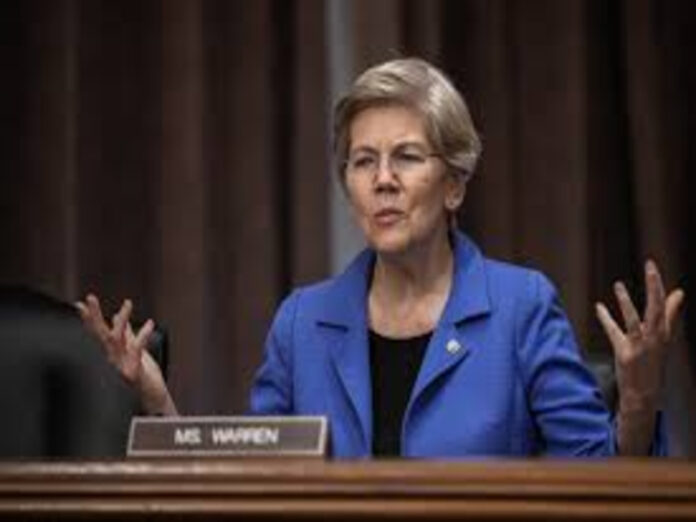
WASHINGTON, DC.- Since President Donald Trump returned to office in January 2025, Senator Elizabeth Warren (D-MA) has emerged once again as one of the loudest voices predicting economic disaster. From cable news appearances to Senate floor statements, Warren has repeatedly warned that the administration’s economic policies, particularly tariffs and industrial protection measures, would drive prices higher, suppress wages, and “crash” the U.S. economy.

Those warnings, delivered with certainty and urgency, have not been borne out by events.
Nearly a year into President Trump’s second term, inflation has moderated from post-pandemic highs, consumer spending has remained resilient, employment levels have stayed historically strong, and several key household costs have stabilized or declined. While the economy is not without challenges, the catastrophic scenario Warren predicted has simply not materialized.
That gap between rhetoric and reality now defines Warren’s economic commentary.
A Timeline Of Fear That Failed To Materialize;
On January 21, 2025, one day after President Trump’s inauguration, Warren appeared on MSNBC, warning that renewed tariffs would be “a direct tax on working families” and would “almost immediately raise prices across the economy.” She claimed the administration was “playing roulette with the American economy.”
Less than two weeks later, on February 3, 2025, Warren issued a public statement asserting that the White House’s trade agenda would “trigger a wave of inflation worse than what Americans just lived through,” adding that consumers should “brace for higher prices at the checkout line.”
By March 12, 2025, as new tariff schedules took effect, Warren escalated her language during remarks on the Senate floor, stating that the administration was “driving the economy toward a cliff” and warning of “serious economic pain by summer.”
Summer came, and those predictions did not.
Consumer price data through mid-2025 showed inflation continuing to ease rather than accelerate. Energy costs stabilized. Supply chains, strengthened by increased domestic production, proved less vulnerable to foreign disruptions. Retail sales data reflected continued consumer confidence, including strong discretionary spending.
Yet Warren did not recalibrate.
On June 18, 2025, she again claimed on CNN that tariffs were “quietly crushing families,” despite emerging data showing flat or declining prices in several tariff-affected categories. The narrative remained unchanged, even as evidence moved in the opposite direction.
The Politics Of Permanent Crisis;
Why does Warren persist in spreading economic alarm even as conditions stabilize?
The answer appears less economic than political.
Progressive Democrats have spent years advancing a narrative that the American economy is structurally broken, incapable of functioning without aggressive federal intervention. This worldview depends on the idea that markets routinely fail and that prosperity is always fragile unless centrally managed.
Acknowledging that prices are easing, wages are holding, and consumer confidence is recovering undermines that ideological framework. It weakens the argument for sweeping regulatory expansion and massive federal spending.
Fear, by contrast, is politically useful. It mobilizes donors, energizes activist bases, and keeps ideological coalitions unified. But fear does not make for sound economic analysis.
What Americans Are Actually Experiencing;
For many Americans, daily economic life in 2025 does not resemble the crisis Warren describes.
Grocery prices, while still elevated compared to pre-pandemic levels, have stopped climbing. Gas prices have trended downward in many regions. Holiday and summer retail spending exceeded expectations. Employment remains strong, and layoffs have not spiked as predicted.
These realities matter.
When elected officials insist the economy is failing despite contrary evidence, voters notice the disconnect between lived experience and political messaging. Over time, that disconnect erodes trust, not in markets, but in those delivering the warnings.
Criticism Requires Credibility;
Criticism of economic policy is both legitimate and necessary. Democracies depend on it. What undermines public discourse is the refusal to adjust claims when forecasts fail.
Since January 2025, Warren has offered no public acknowledgment that her predictions of immediate inflation spikes and economic collapse were wrong. Instead, she continues to repeat them, even as new data contradicts earlier assertions.
Credibility in economic leadership requires humility. Thus far, Warren has shown little.
Sen. Warren’s Criticism Is Just Another Democratic Falsehood
Elizabeth Warren’s continued portrayal of the U.S. economy as teetering on collapse is increasingly disconnected from reality. Her warnings since January 2025, delivered with confidence and urgency, have not been validated by outcomes Americans can see and feel.
The economy has not crashed. Prices have not surged as predicted. Consumer spending has not collapsed. Repeating claims of doom in the absence of evidence does not inform the public; it misleads it.
If Democrats wish to rebuild trust on economic issues, they must engage honestly with data, even when it complicates their political narrative.
Fear may win headlines. Facts win credibility.
Editor’s Note:
This op-ed reflects the analysis and opinion of Jennifer Hodges, Political Editor, and Haylee Ficuciello, for Englebrook Independent News. Statements regarding Senator Elizabeth Warren’s public remarks are based on documented media appearances and Senate statements made between January and June 2025. Economic observations are drawn from publicly available inflation data, consumer spending reports, and labor market indicators.
Englebrook Independent News remains committed to fact-based, evidence-supported journalism and encourages readers to review primary data sources.