DOJ Cites Long-Running Narco-Terror Case; Maduro & Cilia Flores Moved To USS Iwo Jima Ahead Of New York Court Appearance
Saturday, January 3, 2026, 3:00 P.M. ET. 7 Minute Read, By Jennifer Hodges, Political Editor & Art Fletcher, Executive Editor: Englebrook Independent News,
PALM BEACH, FL.- The U.S. Department of Justice, working in conjunction with the U.S. military, carried out a pre-dawn operation in Caracas on Saturday that President Donald Trump said resulted in the capture of Venezuelan leader Nicolás Maduro and his wife, Cilia Flores. U.S. authorities have accused the couple for years of leading a transnational criminal network tied to narcotics trafficking, weapons offenses, and violence linked to cocaine shipments bound for the United States.

According to Trump and multiple U.S. and international news reports, the mission unfolded overnight, with U.S. aircraft striking Venezuelan military targets and air defenses, followed by a rapid raid by elite U.S. troops and federal agents who entered or approached Maduro’s secured location in the capital. The operation culminated in the seizure of Maduro and Flores and their removal from Venezuelan territory.
At a news conference at Trump’s Mar-a-Lago club later Saturday morning, the president declared the United States would “run” Venezuela for an unspecified period “until such time as we can do a safe, proper and judicious transition,” framing the action as both a law-enforcement matter and a national-security operation aimed at dismantling what he described as a “criminal enterprise” operating under the cover of an “illegitimate” regime.
The Operation: Airstrikes, A Rapid Raid, And Extraction;
The mission, identified by U.S. officials as Operation Absolute Resolve, was planned over months and executed overnight after a visible U.S. military buildup in the Caribbean that had publicly been described as anti-narcotics operations.
Accounts from officials familiar with the planning described U.S. special operations forces training on a full-scale replica of Maduro’s fortified location. Intelligence services tracked Maduro’s movements in advance of the raid. During the strike window, U.S. aircraft hit air-defense and command-and-control targets in and near Caracas, clearing the way for a short-duration ground action.
U.S. military officials said the raid window opened at approximately 1:01 a.m. Eastern Time, when U.S. forces moved on the compound. Fire reportedly broke out, and at least one aircraft sustained minor damage but remained operational. Trump later described the site as a “very highly guarded… fortress,” claiming U.S. forces breached reinforced entry points within seconds.
Administration officials emphasized that no American service members were killed during the operation and that no U.S. military aircraft, vessels, or equipment were lost or captured during the raid, underscoring what Pentagon officials described as a “precisely executed, limited-duration mission.”
Explosions were reported in parts of Caracas for less than 30 minutes. Venezuelan officials alleged that civilian and military sites were struck and reported casualties without providing verified figures. Trump said some U.S. personnel sustained minor injuries but confirmed that there were no U.S. fatalities.
Detention At Sea, Then New York Arraignment;
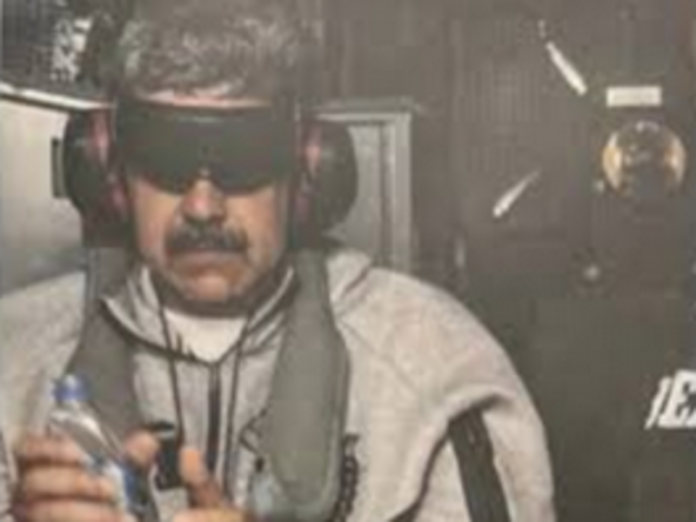
Trump said Maduro and Flores were taken into custody by U.S. federal law enforcement agents and transferred to the amphibious assault ship USS Iwo Jima, operating in the Caribbean. From there, the administration said, both detainees would be flown to New York.
The Justice Department’s stated plan is to arraign Maduro and Flores in federal court in New York, where prosecutors will seek their continued detention pending trial on charges stemming from a long-running narcotics and weapons case.
What The U.S. Says Maduro Is Charged With;
The Justice Department’s case against Maduro dates to March 26, 2020, when U.S. prosecutors announced sweeping charges accusing him and other senior Venezuelan figures of narco-terrorism, corruption, and drug trafficking. Prosecutors alleged Maduro partnered with the FARC and other groups to use cocaine “as a weapon” to destabilize the United States by flooding it with narcotics.
A superseding indictment linked to the Southern District of New York lists Maduro and Flores among defendants accused of conspiracies involving cocaine manufacture and distribution, international importation, and firearms offenses “during and in relation to a drug-trafficking crime.” The charging documents identify Flores by her full name, Cilia Adela Flores de Maduro.
U.S. officials said a newly unsealed indictment released Saturday expands on earlier allegations and characterizes Venezuela’s governing structure as a “corrupt, illegitimate government” fueled by organized crime.
Rubio, Hegseth, And Senior Officials Frame Maduro As A Fugitive;
Administration officials repeatedly emphasized Saturday that Maduro is not being treated as a legitimate head of state but as an indicted fugitive.
Secretary of State Marco Rubio said Maduro “had multiple opportunities to avoid this,” adding, “Nicolás Maduro was indicted in 2020 in the United States. He is not the legitimate president of Venezuela. He is a fugitive of American justice.”
Defense Secretary Pete Hegseth was identified as part of a small group of senior advisers who had been involved in months of planning alongside Rubio and intelligence officials.
Senior military leaders described an extensive rehearsal cycle involving multiple services and hemispheric bases, underscoring the administration’s claim that the mission was designed to minimize risk while achieving what officials called a “law-enforcement objective.”
Attorney General Pam Bondi said the department would pursue the case “to the fullest extent of the law,” emphasizing that the charges are rooted in federal indictments approved years earlier by U.S. courts.
“We’re Going To Run The Country”: Trump’s Claims About Control And Oil;
Trump’s most sweeping remarks addressed what he said would happen next in Venezuela.
“We’re going to run the country until such time as we can do a safe, proper, and judicious transition,” Trump said at Mar-a-Lago, adding that he would not rule out additional U.S. ground forces if necessary. “We’re not afraid of boots on the ground.”
Trump also asserted the U.S. presence would not impose long-term costs on American taxpayers, suggesting the effort could be offset by access to Venezuela’s oil reserves, comments that immediately raised questions about the scope and duration of U.S. involvement.
Venezuela’s Response: Leadership Change And Transition Talks;
Inside Venezuela, senior officials acknowledged a rapid political transition following Maduro’s capture. Venezuelan Vice President Delcy Rodríguez was sworn in as Venezuela’s interim president, according to statements issued by officials aligned with the transitional authority.
U.S. officials said Rodríguez subsequently held a direct conversation with Secretary of State Marco Rubio, during which she agreed to cooperate with the United States “on whatever is necessary” to stabilize the country during the transition period. Administration officials described the discussion as focused on maintaining public order, safeguarding critical infrastructure, and laying the groundwork for internationally monitored elections.
Rodríguez, in a brief statement released through state channels, called for calm and said her government would work with international partners “to ensure peace, continuity of essential services, and a lawful transition.”
What Is Verified, And What Remains Unresolved;
Multiple elements of the story are corroborated across official statements: the overnight strikes and raid in Caracas; the capture of Maduro and Flores; their detention aboard the USS Iwo Jima; confirmation that no U.S. service members or equipment were lost; and the administration’s plan to transport the detainees to New York for arraignment.
At the same time, significant questions remain unresolved as of Saturday afternoon:
- How the U.S. intends to “run” Venezuela in practical terms, including governance, security, and international recognition.
- The precise legal authority underpinning the military component of the operation and the extent of congressional consultation.
- Casualty figures and damage assessments, which Venezuelan officials allege include civilian harm, but have not been independently verified.
For now, the Justice Department’s case, built on allegations first made public in 2020 and reinforced by newly unsealed charging documents, appears poised to become the central forum in which the U.S. seeks to justify the extraordinary seizure of a sitting foreign leader. The administration’s argument is that the action constitutes the arrest of an indicted defendant, not the opening of a war—an assertion that will face intense legal, diplomatic, and historical scrutiny in the days ahead.
Editor’s Note:
This follow-up report reflects information publicly available as of Saturday, January 3, 2026, including statements by President Trump and senior U.S. officials regarding the capture and detention of Nicolás Maduro and Cilia Flores, as well as announced transitional developments in Caracas. Details concerning the scope of U.S. involvement, the duration of the transition, casualty figures, and the timeline for arraignment remain fluid. Englebrook Independent News will continue to verify court filings, diplomatic readouts, and on-record briefings as additional facts emerge. By Jennifer Hodges, Political Editor & Art Fletcher, Executive Editor, Englebrook Independent News.