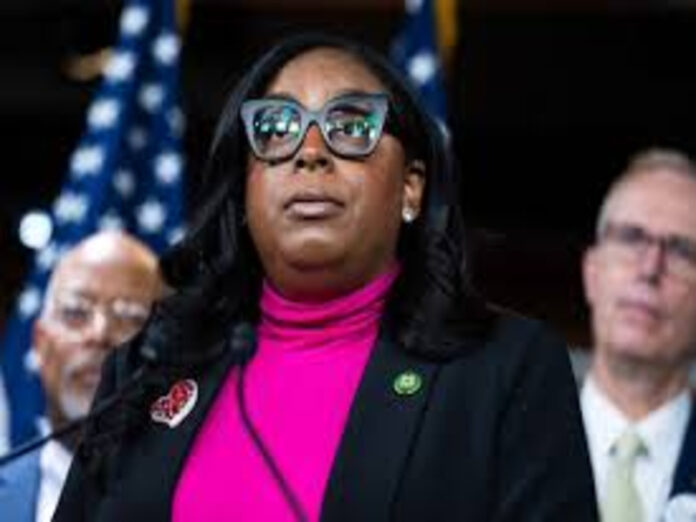
Congressional Immunity Claim Rejected; Case Stemming From Newark Detention Facility Incident Ordered To Proceed Toward Trial
Tuesday, January 6, 2026, 10:45 A.M. ET. 4 Minute Read, By Jennifer Hodges, Political Editor: Englebrook Independent News,
NEWARK, NJ.- A federal judge on Monday, January 5, 2026, formally denied U.S. Representative LaMonica McIver (D-N.J.)’s renewed request to dismiss the federal criminal indictment she faces for allegedly obstructing and impeding federal officers during a confrontation last year at Delaney Hall, a federally contracted immigration detention facility in Newark.

In a written order issued from the U.S. District Court for the District of New Jersey, Jamel K. Semper rejected McIver’s arguments that her conduct was protected under the Constitution’s Speech or Debate Clause, which grants members of Congress limited immunity for legitimate legislative acts. The ruling clears the way for the case to proceed toward trial.
McIver, a first-term congresswoman representing New Jersey’s 10th Congressional District, was indicted by a federal grand jury in June 2025 on three criminal counts, including forcibly impeding and interfering with federal officers during a May 9, 2025, incident involving the arrest of Newark Mayor Ras Baraka outside Delaney Hall.
Court Rejects Congressional Immunity Argument;
In his ruling, Judge Semper determined that McIver’s actions during the confrontation fell outside the scope of protected legislative activity, despite her claims that she was conducting lawful congressional oversight of federal immigration enforcement operations.
“The Speech or Debate Clause does not extend to physical interference with law enforcement officers engaged in the execution of their duties,” Semper wrote, concluding that McIver failed to establish that her conduct was “integral to the deliberative or communicative processes by which Members participate in committee and House proceedings.”
The court rejected McIver’s assertion that her presence at the facility transformed the encounter into a constitutionally protected act, emphasizing that physical obstruction of an arrest, regardless of political motivation, is not shielded by congressional immunity.
Details Of The Alleged Incident;
According to the Department of Justice, the May 9, 2025, incident unfolded when federal officers attempted to arrest Mayor Baraka outside Delaney Hall following an unauthorized entry onto secured property. Prosecutors allege that McIver physically intervened by placing her arms around the mayor and striking at least one federal officer with her forearm in an effort to prevent the arrest.
The confrontation escalated rapidly, drawing additional officers and resulting in Baraka being taken into custody. McIver was not arrested at the scene but was later charged following a federal investigation into the incident.
Selective Prosecution Claims Also Dismissed;
McIver’s legal team also argued that the case represented selective and vindictive prosecution, citing past federal pardons issued to individuals convicted of similar offenses. Judge Semper dismissed that argument as well, stating that McIver failed to demonstrate that similarly situated individuals were treated differently or that the prosecution was motivated by political animus.
The judge ruled that the charging decisions fell squarely within prosecutorial discretion and were supported by probable cause and evidence presented to the grand jury.
Potential Penalties And Next Steps;
McIver faces up to 17 years in federal prison if convicted on all counts, including two felony charges carrying potential sentences of up to eight years each, and a misdemeanor count punishable by up to one year.
While Judge Semper previously reserved judgment on one count pending further evidentiary review, his January 5, 2026, order denied McIver’s renewed motion to dismiss, effectively allowing the prosecution to move forward on the remaining charges.
A trial date has not yet been scheduled. McIver has indicated she intends to continue contesting the charges and may seek appellate review of the constitutional issues raised in her defense.
Broader Legal And Political Implications;
The case is being closely watched by legal scholars and lawmakers nationwide, as it raises significant questions about the limits of congressional oversight, the scope of legislative immunity, and the accountability of elected officials when interacting with federal law enforcement.
Judge Semper’s ruling reinforces longstanding precedent that members of Congress are not exempt from criminal liability for conduct unrelated to core legislative functions, even when actions occur in politically charged contexts.
Editor’s Note:
Verified by Jennifer Hodges and Art Fletcher. This report is based on official court orders issued January 5, 2026, prior judicial rulings from November 2025, Department of Justice filings, and contemporaneous reporting. All dates, charges, judicial findings, and potential penalties have been independently confirmed for accuracy.