Washington-Led Forces Escalate Operation Hawkeye Strike After Deadly December Ambush
Sunday, January 11, 2026, 12:15 P.M. ET. 4 Minute Read, By Jennifer Hodges, Political Editor: Englebrook Independent News,
DAMASCUS, SY.- The U.S. military, alongside partner forces including those from Jordan, carried out a substantial second wave of airstrikes on Saturday against Islamic State (ISIS) positions across Syria, intensifying a campaign of retaliation and counter-terrorism operations that began late last year.
The strikes, described by U.S. Central Command (CENTCOM) as “large-scale,” were executed beginning around 12:30 p.m. Eastern Time and targeted multiple ISIS-controlled locations throughout Syrian territory. Military officials said the operation, part of what the Pentagon has formally designated Operation Hawkeye Strike, is designed to degrade the extremist group’s ability to regroup and launch further attacks against Western and allied forces operating in the Middle East.

Saturday’s bombardment marked the first major U.S. aerial assault of 2026 against ISIS in Syria and follows the initial wave of strikes conducted on December 19, 2025, under the same operational name. That first round of attacks targeted an estimated 70 ISIS positions, including weapons depots, command centers, and logistical infrastructure across central Syria.
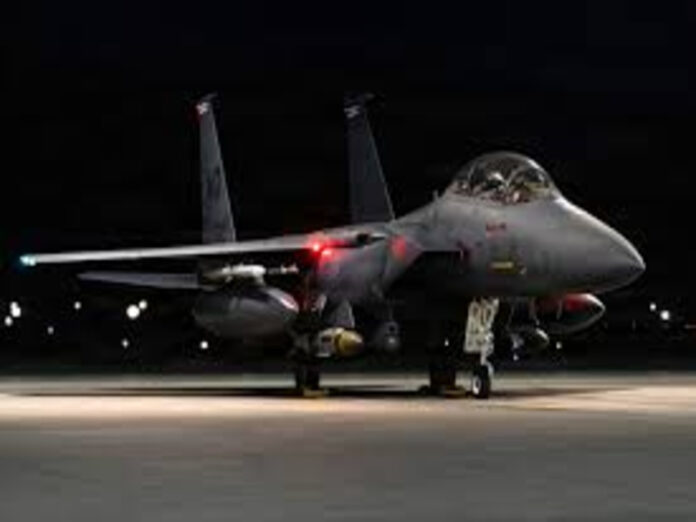
According to defense officials familiar with the operation, more than 20 coalition aircraft participated in Saturday’s mission. Those assets reportedly included U.S. Air Force F-15E Strike Eagles, A-10 Thunderbolt II “Warthogs,” AC-130J Ghostrider gunships, and MQ-9 Reaper drones, as well as Royal Jordanian Air Force F-16 fighter jets operating alongside U.S. forces.
CENTCOM confirmed that the mission focused on ISIS targets “throughout Syria” and reinforced that the United States would respond decisively to any attacks on American personnel.
“Attacks on American warfighters will not go unanswered,” CENTCOM stated, signaling continued military pressure on the terror network.
Background: The December Ambush;
The renewed air campaign was triggered by a deadly ISIS ambush on December 13, 2025, near Palmyra, Syria, where two U.S. soldiers and an American civilian interpreter were killed during a joint patrol.
The fallen service members were:
- Sgt. Edgar Brian Torres-Tovar, 25
- Sgt. William Nathaniel Howard, 29
Both soldiers were members of the Iowa National Guard. They were accompanied by Ayad Mansoor Sakat, a U.S.-employed interpreter, who was also killed in the attack. Several additional U.S. troops were wounded.
ISIS claimed responsibility for the ambush, which U.S. intelligence later confirmed was carried out by militants tied to the organization’s Syrian network.
President Donald Trump described the broader response as a necessary escalation to ensure the safety of U.S. forces and regional allies.
“We will root out Islamic terrorism that targets our troops and our partners,” the president said following the first wave of December strikes.
Regional And Strategic Impact;
Jordan publicly confirmed its role in Saturday’s air campaign, emphasizing the importance of regional cooperation to prevent ISIS from re-establishing operational strongholds in Syria and neighboring territories.
Syrian authorities have also reported that a senior ISIS commander responsible for coordinating militant activity across the Levant region was recently captured, a development viewed by military analysts as a direct result of the sustained U.S.-led pressure campaign.
The Pentagon has not yet released confirmed casualty numbers for ISIS fighters or assessed possible civilian impacts from the latest strikes, citing the ongoing nature of post-strike intelligence analysis. Independent monitoring groups, including regional human-rights organizations, typically release figures in the days following major air operations.
Defense analysts note that the renewed U.S. offensive reflects a broader strategic shift, one that combines aerial firepower, special-operations missions, and intelligence-driven targeting to ensure ISIS remains fragmented and incapable of conducting large-scale attacks.
A Continuing Campaign;
The second wave of Operation Hawkeye Strike underscores Washington’s determination to prevent ISIS from exploiting instability in Syria. Military leaders say the operation will continue for as long as intelligence indicates ISIS retains the capability to threaten U.S. personnel or allied governments.
With coalition aircraft now flying regular missions over ISIS-controlled territory, U.S. officials believe the terror group’s command structure and operational capacity are once again under severe strain.
Editor’s Note:
This article was written by Jennifer Hodges, Political Editor, for Englebrook Independent News using verified reporting from U.S. Central Command briefings, international wire services, and defense-sector sources tracking coalition military operations in Syria. All facts and timelines reflect information confirmed as of January 11, 2026.