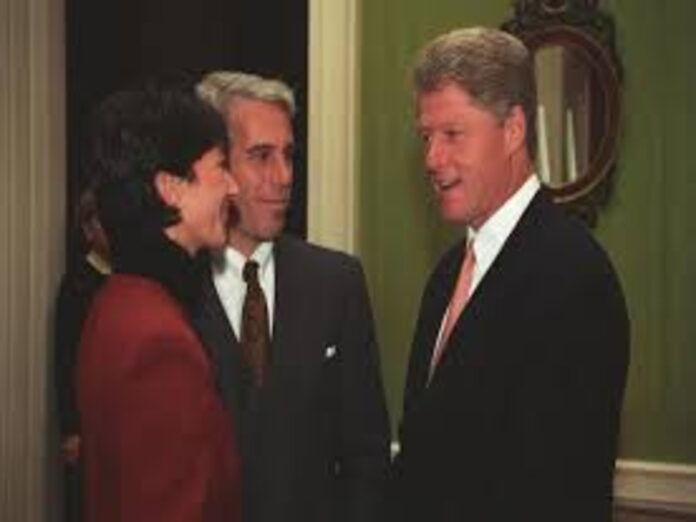
Former President Bill Clinton & Hillary Clinton Refuse To Testify Before House Oversight Committee In Jeffrey Epstein Investigation; Committee To Vote On Contempt & Refer Matter To DOJ
Wednesday, January 14, 2026, 7:00 A.M. ET. 5 Minute Read, By Jennifer Hodges, Political Editor: Englebrook Independent News,
WASHINGTON, DC.- Former President Bill Clinton and former Secretary of State Hillary Clinton have refused to appear before the Republican-led U.S. House Oversight Committee to testify about their contacts and connections to disgraced financier Jeffrey Epstein, defying issued congressional subpoenas and propelling the committee toward formal contempt of Congress proceedings that could be voted on as early as next week.

The committee’s action marks a rare escalation in the enforcement of congressional subpoenas and puts the couple on a potential collision course with the Department of Justice (DOJ), which could choose whether to pursue criminal contempt charges similar to the prosecutions brought against former Trump advisers Steve Bannon and Peter Navarro in separate contempt cases, a question that remains unresolved.
Clintons Reject Subpoenas As ‘Politically Motivated;’
In a joint letter to Oversight Committee Chairman Rep. James Comer (R-Ky.), released publicly, the Clintons asserted that they would not comply with the subpoenas, arguing the committee’s inquiry lacked legal validity and was aimed at embarrassing political rivals rather than serving a legitimate legislative purpose.
“Every person has to decide when they have seen or had enough and are ready to fight for this country, its principles, and its people, no matter the consequences. For us, now is that time,” the letter stated.
The Clintons also claimed they have already provided all relevant information they possess about Epstein and his associate Ghislaine Maxwell, and accused the committee of selective and partisan enforcement.
Oversight Committee Pushes Forward;
Chairman Comer confirmed that Bill Clinton failed to appear for a scheduled closed-door deposition on Tuesday, January 13, 2026, as part of the committee’s expanding investigation into Epstein’s criminal enterprise and whether influential political figures possessed information that was not disclosed.
Comer announced he will proceed with contempt proceedings, which will include a committee vote followed by a possible full House vote to formally refer the matter to the Department of Justice.
“It’s unacceptable to refuse to comply with a duly authorized congressional subpoena in our Epstein investigation,” Comer said. “No one is above the law.”
Both Republicans and some Democrats on the committee acknowledge that contempt citations are extraordinary measures, but argue the subpoenas were lawfully issued and necessary to advance Congress’s oversight responsibilities.
Legal And Historical Stakes;
Contempt of Congress is a federal offense that applies when a witness willfully refuses to comply with a lawful congressional subpoena. If the House votes to refer the Clintons for criminal contempt, the matter is transmitted to the U.S. Attorney for the District of Columbia, who acts under DOJ authority.
This is the same process used in the cases of Steve Bannon and Peter Navarro, both of whom were criminally prosecuted after defying subpoenas from the House January 6th Committee.
However, legal precedent also makes clear that the Department of Justice is not required to bring charges, even after a referral. Prosecutors may decline based on legal defenses, separation-of-powers concerns, or prosecutorial discretion, making the Clintons’ ultimate legal exposure uncertain.

Epstein Probe Context;
The subpoenas were issued as part of a broader congressional effort to examine how Jeffrey Epstein was able to evade accountability for decades, and to determine whether political figures, federal agencies, or law-enforcement officials failed to act on credible evidence of his crimes.
In late 2025 and early January 2026, the Department of Justice began releasing documents under the Epstein Files Transparency Act, a federal law requiring disclosure of unclassified Epstein-related materials, though many records remain redacted to protect victims and ongoing investigations.
Republican lawmakers have cited flight logs, photographs, and documented meetings between Bill Clinton and Epstein as justification for seeking sworn testimony, arguing that voluntary statements are insufficient.
Clinton has repeatedly denied any knowledge of Epstein’s criminal conduct and insists his interactions were limited and professional.
Political And Legal Implications;
The showdown has deepened partisan tensions in Washington. Supporters of the Oversight Committee argue the subpoenas are a matter of equal accountability under the law, while critics argue they amount to politically driven retribution against a former Democratic administration.
Legal experts note that compelling testimony from a former president and former secretary of state raises complex constitutional and procedural questions that could take months or years to resolve in court.
What Happens Next;
The House Oversight Committee is expected to vote within days on contempt resolutions against Bill Clinton and potentially Hillary Clinton if she continues to refuse compliance. If approved, the matter will be formally referred to the Department of Justice for consideration of criminal prosecution.
Whether the DOJ will treat the Clintons as it treated Bannon and Navarro remains an open and politically explosive question, one that could redefine congressional subpoena enforcement for years to come.
Editor’s Note:
This report is based on verified public reporting and congressional records available as of publication. Any decision to pursue criminal contempt charges rests solely with the U.S. Department of Justice following formal referral by the House of Representatives. By Jennifer Hodges, Political Editor, Englebrook Independent News.