GOP Blocks Limits On Trump Authority, Dealing Blow To Democrats
Thursday, January 15, 2026, 12:00 P.M. ET. 4 Minute Read, By Jennifer Hodges, Political Editor: Englebrook Independent News,
WASHINGTON, DC.- Senate Republicans delivered a decisive political and legislative blow to Democrats Wednesday night by killing a War Powers Resolution that would have restricted President Donald Trump’s authority to conduct further military operations in Venezuela without explicit congressional approval.
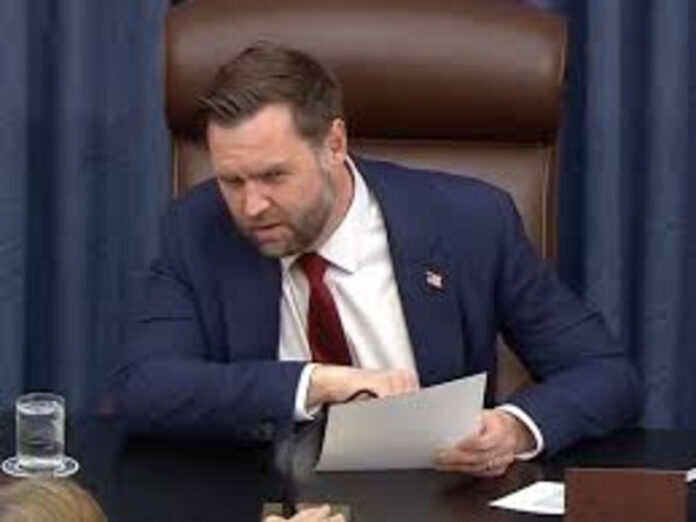
In a dramatic 51–50 vote, Vice President J.D. Vance cast the tie-breaking vote to halt the measure, preventing it from advancing to final passage. The resolution, sponsored by Sen. Tim Kaine (D-VA), sought to require the White House to obtain congressional authorization before engaging in additional military action “within or against Venezuela.”

The defeat marked a significant setback for Democrats, who have been attempting to slow or block President Trump’s aggressive posture toward Venezuela following a series of U.S. operations targeting the regime of longtime socialist strongman Nicolás Maduro that led to his arrest on U.S. Federal narcotics and weapons charges.
The measure had initially gained rare bipartisan traction. Five Republican senators had joined Democrats earlier in the process to advance the resolution out of committee. But after intense pressure from the White House and Republican leadership, at least two of those GOP senators, Josh Hawley of Missouri and Todd Young of Indiana, reversed their positions, allowing Republicans to successfully kill the bill on the Senate floor.
White House Mobilizes Against The Resolution;
The Trump administration actively worked behind the scenes to ensure the resolution’s defeat. Senior White House officials warned that the measure would undermine U.S. leverage in Venezuela at a critical moment and could restrict the president’s ability to respond rapidly to threats against American interests and allies in the region.
President Trump personally weighed in, sharply criticizing Republican lawmakers who initially supported the measure and warning that it would embolden Maduro’s remaining loyalists, as well as U.S. adversaries including China, Russia, and Iran.
Administration officials also circulated written assurances to Republican senators stating that there were no plans to deploy U.S. ground troops in Venezuela and that any major military escalation would still involve congressional consultation when appropriate.
Democrats Decry Loss Of Congressional Authority;
Democrats reacted angrily to the outcome, arguing that the Senate had surrendered its constitutional role in decisions of war and peace.
“This is about whether Congress has any say at all before American forces are placed in harm’s way,” said Sen. Kaine following the vote. “Tonight, the Senate abdicated that responsibility.”
Senate Majority Leader Chuck Schumer (D-NY) accused Republicans of placing blind loyalty to President Trump above constitutional governance. “The founders vested war-making power in Congress for a reason. Tonight, Republicans handed that power away.”
Republicans Defend Trump’s Authority;
Republican leaders countered that the War Powers Resolution was both unnecessary and misleading. Senate Majority Leader John Thune (R-SD) said the legislation was based on a false premise that the United States was already at war with Venezuela.
“This resolution attempts to solve a problem that does not exist,” Thune said. “The president is operating within existing law to protect U.S. national security.”
Republicans also argued that Trump’s actions against Maduro’s regime, including intelligence operations, asset seizures, and limited military engagements, fall under counter-narcotics and international law-enforcement authorities, not traditional warfare requiring congressional declarations.
High-Stakes Battle Over Venezuela;
The vote comes amid rapidly evolving U.S. involvement in Venezuela. Over the past several weeks, the Trump administration has intensified pressure on Maduro’s socialist government, which Washington blames for massive corruption, drug trafficking, and human-rights abuses.
U.S. operations have already resulted in the capture of senior regime officials and the seizure of billions of dollars in assets tied to Venezuela’s state-run oil industry. The administration has framed its actions as part of a broader effort to restore democracy and cripple criminal networks operating under the Maduro regime.
Democrats, however, argue those operations risk escalating into open conflict without proper oversight, a claim Republicans reject.
What Comes Next;
Although the War Powers Resolution failed, Democratic leaders say they are not backing down. Similar legislation is expected to be introduced in the House of Representatives, and Senate Democrats have vowed to continue pressing the issue in future votes.
For now, President Trump retains full authority to continue U.S. military and security operations in Venezuela without additional congressional approval, a victory for the White House and a significant defeat for Democrats who have sought to restrain him.
Editor’s Note:
This article has been reviewed for factual accuracy and prepared for publication by Jennifer Hodges, Political Editor, Englebrook Independent News. Reporting is based on confirmed congressional records, floor votes, and statements from U.S. Senate leadership and the White House.