New Governor Rescinds Directive Pushing Virginia Agencies Into 287(g) Partnerships, Arguing State Resources Should Prioritize Community Policing
Sunday, January 18, 2026, 8:15 A.M. ET. 3 Minute Read, By Jennifer Hodges, Political Editor: Englebrook Independent News,
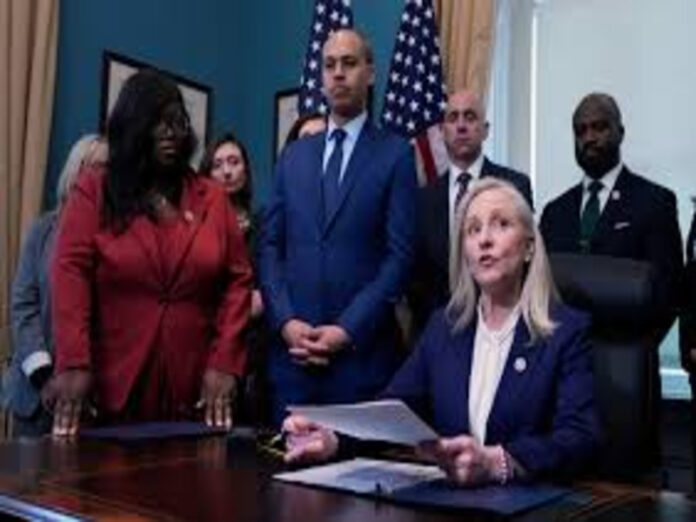
RICHMOND, VA.- Abigail Spanberger was sworn in Saturday as Virginia’s 75th governor, the first woman elected to lead the commonwealth and, within hours, moved to unwind a signature immigration-enforcement policy of outgoing Republican Gov. Glenn Youngkin by rescinding his directive that pushed Virginia agencies to formalize cooperation with U.S. Immigration and Customs Enforcement.

According to multiple reports and details discussed publicly at the Capitol, Spanberger’s action rescinded Youngkin’s immigration-related executive order that directed state entities, including the Virginia State Police, the Department of Corrections, and the Secretary of Public Safety, to pursue participation in 287(g) programs, a federal partnership framework administered by U.S. Immigration and Customs Enforcement that authorizes trained state or local officers to assist in certain federal immigration-enforcement functions.
A Day-One Reversal With Immediate Political Impact;
Spanberger’s swift reversal signaled a clear break from Youngkin’s approach, which framed closer cooperation with ICE as a public-safety measure and an operational alignment with federal enforcement priorities. In contrast, Spanberger argued the directive risked diverting limited state and local law-enforcement resources away from core policing responsibilities and criminal investigations, emphasizing that enforcement of civil immigration law remains primarily a federal responsibility.
The move was among the first executive actions taken by the new governor and underscored the administration’s intent to reset Virginia’s posture on immigration enforcement at the state level.
Inauguration Setting And New Statewide Leadership;
Spanberger took the oath of office at the Virginia State Capitol in Richmond, marking a significant political transition after four years of Republican control of the executive branch under Youngkin.
Saturday’s inauguration also included the swearing-in of Lieutenant Governor Ghazala Hashmi and Attorney General Jay Jones, completing a statewide Democratic sweep and signaling the likelihood of broader policy changes in the early months of the new administration.
What The Rescission Means In Practice;
While the operational scope of cooperation between law enforcement and ICE varies by jurisdiction, the rescinded directive centered on encouraging Virginia state agencies to enter formal 287(g) partnerships. Those agreements allow participating officers, after federal training and supervision, to perform limited immigration-enforcement functions.
Spanberger’s action does not prevent ICE from operating within Virginia. Instead, it removes the state-level requirement or institutional push for agencies to participate in such partnerships, effectively reversing the Youngkin administration’s policy of formal alignment with federal immigration enforcement efforts.
What Happens Next;
The decision is expected to intensify debate in Richmond over public safety, state-local autonomy, and the appropriate role of state agencies in federal immigration enforcement. With Spanberger’s administration beginning under close national scrutiny, her early executive actions, particularly on immigration cooperation, are likely to serve as an initial test of how the new governor navigates law-enforcement concerns while advancing her broader policy agenda.
Editor’s Note:
This report was written by Jennifer Hodges, Political Editor, and is based on same-day coverage of Gov. Abigail Spanberger’s inauguration and her initial executive actions on Saturday, January 17, 2026, including the rescission of former Gov. Glenn Youngkin’s directive encouraging 287(g) cooperation between Virginia agencies and U.S. Immigration and Customs Enforcement.