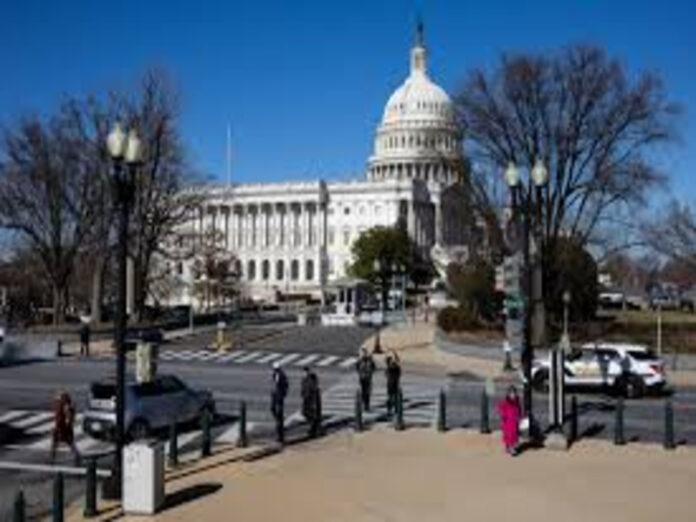
DHS/ICE Funding Dispute Fractures Caucus As Measure Heads To Senate For Do-Or-Die Vote
Friday, January 23, 2026, 12:00 P.M. ET. 4 Minute Read, By Haylee Ficuciello, Economy & Finance Editor: Englebrook Independent News,
WASHINGTON, DC.- A $1.2 trillion, four-bill federal spending package cleared the U.S. House on Thursday, January 22, 2026, setting up a high-stakes Senate showdown ahead of a January 30 deadline that would otherwise trigger a partial government shutdown for the agencies covered by the expiring funding window.

The day’s most contentious vote centered on the Department of Homeland Security (DHS), and specifically funding and oversight provisions tied to U.S. Immigration and Customs Enforcement (ICE), where Democratic leaders urged opposition. Despite that push, seven House Democrats broke with House Minority Leader Hakeem Jeffries and voted with Republicans to advance the DHS bill and help move the broader end-of-cycle spending package forward.
The Vote And What Passed;
The House approved the DHS measure 220–207, with all but one Republican voting “yes” and seven Democrats joining them. Separate votes also advanced the other three appropriations bills, with the broader grouping for major domestic and defense-related departments passing by a wide bipartisan margin, reported as 341–88.
According to the package’s reporting, the DHS bill would provide approximately $64.4 billion to the department, including about $10 billion for ICE.
The dispute was not simply about topline funding levels. Democrats opposing the DHS measure argued the bill failed to include sufficient constraints on ICE operations amid growing controversy over immigration enforcement practices. Supporters countered that allowing DHS funding to lapse would disrupt national security operations, border infrastructure, disaster response, and aviation security, while doing little in practice to curb enforcement actions.
The Seven Democrats Who Joined Republicans;
The seven House Democrats who voted with Republicans on the DHS funding bill were:
- Rep. Don Davis (D–North Carolina)
- Rep. Tom Suozzi (D–New York)
- Rep. Henry Cuellar (D–Texas)
- Rep. Vicente Gonzalez (D–Texas)
- Rep. Laura Gillen (D–New York)
- Rep. Marie Glusenkamp Perez (D–Washington)
- Rep. Jared Golden (D–Maine)
Several of the lawmakers represent politically competitive districts, including areas that have recently voted Republican at the presidential level.
Why The Package Matters For The Economy;
From a markets and economic management standpoint, the late-January shutdown risk carries real consequences. Even a partial shutdown can delay federal payments, disrupt procurement contracts, stall infrastructure permitting, and inject uncertainty into labor markets tied to government operations.
Economists have repeatedly warned that recurring shutdown brinkmanship undermines long-term fiscal planning, weakens confidence among contractors and investors, and increases administrative costs for both federal agencies and private-sector partners.
What Happens Next In The Senate;
The legislation now heads to the U.S. Senate, where leadership must decide whether to bring the bills forward as a package or separate the DHS measure from the remaining appropriations.
Two factors will determine the outcome:
The deadline: Lawmakers face a hard cutoff of January 30, 2026, to prevent a partial government shutdown.
The vote threshold: Senate procedure generally requires 60 votes to overcome a filibuster. With Republicans holding a narrow majority, passage would likely require support from at least seven Democrats or independents.
What If The Senate Does Not Pass The Bill;
If the Senate fails to pass the spending package before the deadline, Congress would face two immediate options:
- Passage of a short-term continuing resolution, extending current funding levels temporarily; or
- Allowing a partial government shutdown to occur for affected agencies.
Either outcome would reset negotiations and likely force leadership back to the table to revise, repackage, or renegotiate the most controversial elements, particularly DHS and ICE funding provisions.
DHS And ICE Remain The Flashpoint;
While the broader spending package includes defense, transportation, housing, and other domestic agencies, DHS funding emerged as the central fault line. The bill reportedly includes funding for body cameras and internal oversight measures, but does not impose additional enforcement restrictions sought by Democratic leaders.
That unresolved tension now shifts to the Senate, where lawmakers must weigh whether keeping DHS funding intact is the fastest path to keeping the government open, or whether further concessions will be required to secure final passage.
Editor’s Note:
This report was written by Haylee Ficuciello, Economy & Finance Editor for Englebrook Independent News, and is based on contemporaneous House vote data, official appropriations figures, and verified reporting from multiple national news organizations. Vote totals, funding amounts, and the identities of House members crossing party leadership were cross-checked for accuracy prior to publication.