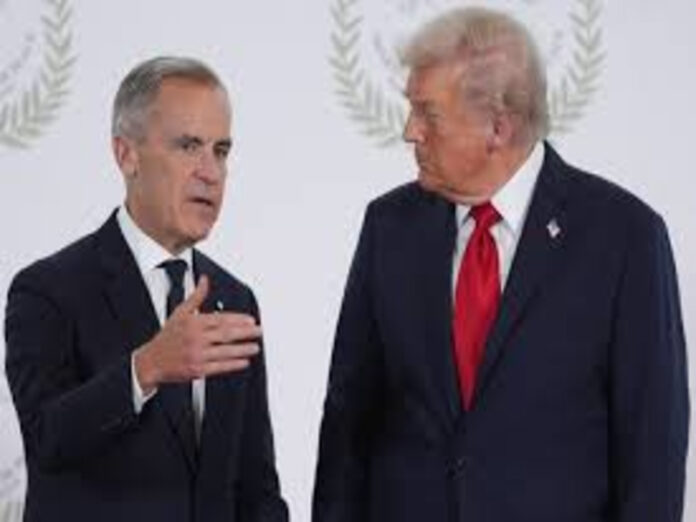
Warning To Prime Minister Mark Carney Escalates U.S.-Canada Trade Tension As Washington Targets Chinese Transshipment Routes
Saturday, January 24, 2026, 3:15 P.M. ET. 4 Minute Read, By Haylee Ficuciello, Economy & Finance Editor: Englebrook Independent News,
WASHINGTON, DC.- President Donald Trump on Saturday warned Canadian Prime Minister Mark Carney that the United States will impose a 100 percent tariff on all Canadian goods if Canada becomes what Trump described as a “drop-off” channel for Chinese goods ultimately bound for the U.S. market, sharply escalating trade pressure on America’s largest trading partner.
The warning was delivered publicly through a social media statement by President Trump, in which he framed the threat as a direct deterrent against any Canada–China trade arrangement that could allow Chinese manufacturers to route products through Canada in order to bypass existing U.S. trade penalties and enforcement measures.

According to multiple reports, Trump stated that if Canada proceeds with any trade agreement or logistical framework that effectively turns the country into a gateway for Chinese exports into the United States, the U.S. response would be swift and severe, with a 100 percent tariff applied to all Canadian imports entering the American market.
In the same message, Trump referred to Prime Minister Carney as “governor,” language he has previously used when criticizing Canadian leadership during trade and diplomatic disputes.
Why The Warning Is Escalating Now;
The dispute comes amid increasing political and economic friction between Washington and Ottawa following Carney’s recent international engagements, including public remarks at the World Economic Forum in Davos and Canada’s renewed diplomatic outreach toward China.
Canadian officials have pushed back against claims that Ottawa is pursuing a sweeping free trade agreement with Beijing. However, reports confirm that Carney recently traveled to China, fueling concern within the Trump administration that Canadian ports, logistics hubs, or manufacturing corridors could be used as transshipment points for Chinese goods seeking entry into the U.S. market.
Economic Stakes For Both Nations;
A blanket 100 percent tariff on Canadian goods would represent one of the most aggressive trade actions taken by the United States against a close ally in modern North American history.
Canada is the United States’ largest trading partner, with deeply integrated supply chains spanning the automotive, metals, energy, agriculture, and manufacturing sectors. A universal tariff of this magnitude would disrupt industries that rely on daily, tightly coordinated cross-border commerce, particularly in sectors where components cross the U.S.–Canada border multiple times before final assembly.
Economists warn that such a move would also inject significant uncertainty into the broader North American trade environment, where stability and predictability are critical to long-term investment decisions.
The “China Backdoor” Concern;
At the core of Trump’s warning is the long-standing trade enforcement issue of transshipment, in which goods are routed through a third country to obscure their true country of origin or to avoid higher tariffs.
While U.S. customs authorities traditionally address transshipment through enhanced inspections, audits, and rules-of-origin enforcement, Trump’s approach signals a willingness to apply sweeping tariff pressure if Canada is perceived as enabling a China-to-U.S. trade corridor.
What Comes Next;
Markets, manufacturers, and policymakers are now closely watching several key developments:
- Whether Canada formally clarifies its trade posture toward China and outlines safeguards to prevent rerouting of Chinese exports.
- Whether the White House or the Office of the U.S. Trade Representative moves beyond rhetoric and initiates formal trade enforcement actions or investigations.
- Potential implications for the United States–Mexico–Canada Agreement (USMCA): a universal tariff threat could trigger political and legal challenges within the North American free trade framework.
For now, the administration’s message is unambiguous: if Canada is viewed as facilitating the indirect entry of Chinese goods into the United States, Washington is prepared to respond with maximum economic leverage.
Editor’s Note:
This report is based on publicly available statements and verified reporting regarding President Donald Trump’s January 24, 2026, remarks, including coverage from Reuters, the Associated Press, and other major international news organizations. Englebrook Independent News will update this article should the White House issue formal policy directives, should Prime Minister Carney’s office provide an on-the-record response, or if U.S. trade agencies initiate official enforcement proceedings related to the tariff threat.