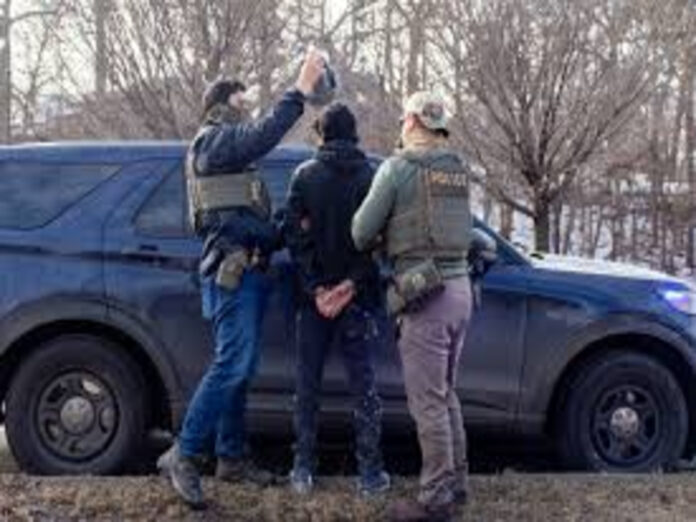
Homan Credits Local Cooperation As Two-Month ICE Operation Winds Down Following Thousands Of Arrests
Thursday, February 12, 2026, 3:00 P.M. ET. 4 Minute Read, By Jennifer Hodges, Political Editor: Englebrook Independent News,
MINNEAPOLIS, MN.- U.S. Border Czar Tom Homan announced Thursday morning that the federal immigration enforcement campaign known as Operation Metro Surge will formally come to an end, citing what he described as a marked increase in cooperation between federal authorities and local and state law enforcement agencies across Minnesota.
Speaking at a 9:00 a.m. press conference from the Bishop Whipple Federal Building in downtown Minneapolis, Homan said the two-month operation achieved its objectives and no longer requires an expanded federal presence in the region.

“Operation Metro Surge is ending,” Homan stated. “Because of the cooperation we are now seeing from local and state partners, there is no longer a need for an increased number of federal agents on the ground.”
Operation Overview And Arrest Figures;
Operation Metro Surge was launched in early December 2025 and focused primarily on the Twin Cities metropolitan area, with additional enforcement actions carried out across Minnesota. According to Homan, the operation resulted in more than 4,000 arrests over the two-month period.
Federal officials emphasized that the enforcement campaign prioritized individuals unlawfully present in the United States who also posed public-safety concerns, including those with criminal histories, gang affiliations, or outstanding warrants.
“This was not random enforcement,” Homan said. “This operation focused on public safety threats, repeat offenders, and individuals who had already ignored lawful removal orders.”
Homan noted that arrests included individuals charged or convicted of offenses ranging from violent crimes to narcotics trafficking, human smuggling, and repeat immigration violations.
Local Cooperation Drives Federal Drawdown;
A central theme of Homan’s remarks was the increased level of coordination between U.S. Immigration and Customs Enforcement (ICE) and Minnesota’s local and state law enforcement agencies. He credited this cooperation as the primary reason federal officials are now scaling back the surge.
According to Homan, local agencies have increased information-sharing related to jail releases, detainers, and criminal case outcomes, allowing ICE officers to operate more efficiently without requiring a large surge of federal personnel.
“We’re seeing cooperation we didn’t have before,” Homan said. “That cooperation allows us to protect communities while reducing the federal footprint.”
Homan confirmed that while most surge agents will be reassigned or returned to their home posts, ICE will maintain a continuing enforcement presence in Minnesota under standard operational protocols.
Public Safety Emphasis Remains;
Homan was clear that the end of Operation Metro Surge does not represent a retreat from immigration enforcement. Instead, he described the shift as a transition from a high-intensity deployment to more targeted, intelligence-driven operations.
“Let me be clear,” he said. “Immigration enforcement is not ending. If you’re here illegally and you pose a threat to public safety, ICE will find you.”
He added that the drawdown reflects fewer incidents requiring rapid federal response and a greater ability for local agencies to manage public-safety risks in coordination with federal partners.
Public Reaction And Broader Context;
Since its launch, Operation Metro Surge has generated a strong public reaction across Minnesota. Demonstrations were held throughout the Twin Cities, while advocacy groups raised concerns about enforcement practices and due process protections.
Homan acknowledged the controversy but defended the operation’s results, arguing that immigration enforcement and public safety are inseparable.
“The first duty of government is to protect its citizens and lawful residents,” he said. “This operation did exactly that.”
Looking Ahead;
When asked whether similar operations could be deployed elsewhere, Homan said the federal government remains prepared to act where local cooperation breaks down, or public-safety risks escalate.
“The model works,” he said. “Strong enforcement combined with strong local partnerships is the path forward.”
As federal agents prepare to depart Minnesota, ICE officials say enforcement efforts will continue under normal operations, with an ongoing focus on criminal offenders and national security threats.
Editor’s Note:
This article was written by Jennifer Hodges, Political Editor, and is based on official statements made during a February 12, 2026, press conference by U.S. Border Czar Tom Homan in Minneapolis, Minnesota. Arrest figures and operational details reflect information released by federal authorities and confirmed through multiple contemporaneous reports available at the time of publication. Figures remain subject to final federal verification.