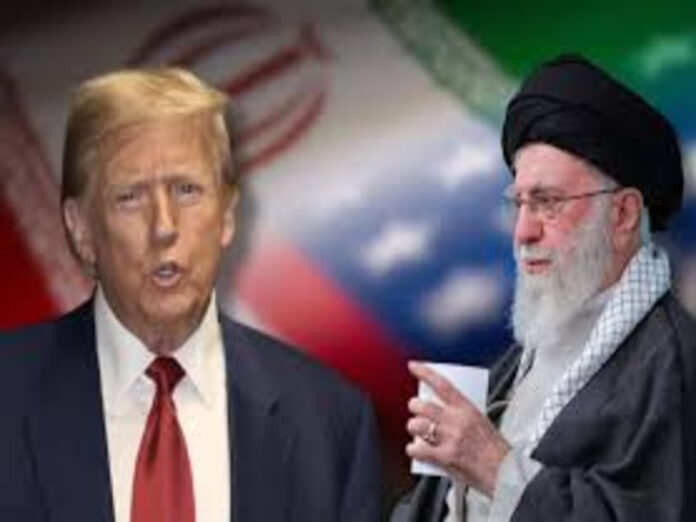
USS Gerald R. Ford Redirected To Join USS Abraham Lincoln Amid Warnings Of “Very Traumatic” Consequences If Talks Fail
Friday, February 13, 2026, 3:35 P.M. ET. 5 Minute Read, By Jennifer Hodges, Political Editor: Englebrook Independent News,
WASHINGTON, DC.- President Donald Trump has ordered a second United States aircraft carrier strike group into the Middle East, sharply escalating American military posture as the administration presses Iran to reach an agreement over its nuclear program or face the possibility of U.S. military action.

U.S. defense officials confirmed that the Pentagon is redeploying the USS Gerald R. Ford, the U.S. Navy’s newest and largest aircraft carrier, from operations in the Caribbean to the Middle East. The move will place two U.S. carrier strike groups in the region, a rare and deliberate show of force intended to reinforce diplomatic pressure on Tehran while preserving military readiness should talks collapse.
The Ford is expected to take at least one week to arrive in theater and will operate alongside the USS Abraham Lincoln, which is already conducting operations in and near the Arabian Sea under U.S. Central Command.
Carrier strike groups involved;
USS Gerald R. Ford Carrier Strike Group
The Ford, commissioned in 2017 and considered the most technologically advanced warship ever built, brings substantial strike, surveillance, and command-and-control capabilities. The carrier can deploy more than 75 aircraft, including F/A-18 Super Hornet fighter jets and E-2D Hawkeye early-warning aircraft.
According to U.S. officials, Ford’s accompanying surface combatants include:
- USS Normandy (Ticonderoga-class guided-missile cruiser)
- USS Thomas Hudner (Arleigh Burke-class guided-missile destroyer)
- USS Ramage (Arleigh Burke-class guided-missile destroyer)
- USS Carney (Arleigh Burke-class guided-missile destroyer)
- USS Roosevelt (Arleigh Burke-class guided-missile destroyer)
Together, these vessels provide layered missile defense, anti-submarine warfare, and long-range strike capabilities.
USS Abraham Lincoln Carrier Strike Group
The USS Abraham Lincoln is already operating in the region with its own complement of guided-missile destroyers and aviation assets. In recent weeks, U.S. officials confirmed that American forces operating near the carrier shot down an Iranian drone that approached the strike group. In a separate incident, Iranian naval forces attempted to stop a U.S.-flagged commercial vessel transiting the Strait of Hormuz, one of the world’s most critical maritime chokepoints.
Trump’s Warning: Diplomacy First, Force If Necessary;
President Trump has repeatedly stated that he prefers a negotiated outcome but has made clear that time is limited.
Speaking to reporters this week, the president said that if Iran does not come to an agreement, the alternative would be severe. “We have to make a deal, otherwise it’s going to be very traumatic,” Trump said, signaling that military action remains a credible option should diplomacy fail.
Following a White House meeting with Israeli Prime Minister Benjamin Netanyahu, Trump reiterated that negotiations are ongoing and that he is willing to allow talks to proceed, but only within a narrow window.
Diplomatic Track: Indirect Talks And Mounting Pressure;
The carrier deployments come as U.S. and Iranian officials have engaged in indirect negotiations, reportedly facilitated by intermediaries in Oman. While both sides have acknowledged the talks, neither has publicly disclosed detailed terms or timelines, and no formal agreement has yet emerged.
Administration officials describe the expanded military posture as a means of strengthening the U.S. negotiating position rather than a signal that war is inevitable. However, the scale of the deployment underscores Washington’s determination to back diplomacy with credible force.
Strategic Significance Of The Carrier Buildup;
Aircraft carriers are among the most flexible instruments of U.S. power projection, capable of conducting sustained air operations without reliance on regional bases. The presence of two carriers dramatically increases the United States’ ability to conduct intelligence collection, air patrols, missile defense, and, if ordered, precision strikes.
The move also highlights strains on U.S. naval resources. The United States maintains 11 aircraft carriers, which defense officials frequently describe as a “scarce resource.” The Ford has been operating at sea for much of the past year, and extended deployments place additional demands on sailors and maintenance schedules.
Regional Risks And Escalation Concerns;
Gulf Arab states have privately and publicly warned that a military confrontation with Iran could rapidly expand into a wider regional conflict, threatening global energy supplies and maritime commerce. Iranian officials, for their part, have repeatedly warned that any U.S. attack would provoke retaliation against American forces and regional allies.
The dual-carrier presence sends a clear signal that the United States is preparing not only to deter Iranian action but also to absorb and respond to potential retaliation.
What To Expect Next;
In the days and weeks ahead, several developments will be closely watched:
- Arrival and operational integration of the USS Gerald R. Ford into U.S. Central Command’s area of responsibility
- Renewed rounds of indirect negotiations between U.S. and Iranian representatives, including whether talks move toward concrete terms or stall
- Iranian military signaling, such as drone activity, naval maneuvers, or missile exercises near U.S. assets
- Further White House or Pentagon statements clarifying whether the carrier buildup remains strictly deterrent or is tied to specific contingency plans
- Regional diplomatic responses, particularly from Gulf allies and Israel, as the deadline for a potential agreement approaches
While administration officials emphasize diplomacy, the expanding U.S. naval footprint makes clear that Washington is preparing for multiple outcomes, and that the margin for miscalculation is narrowing.
Editor’s Note:
This article was written by Jennifer Hodges, Political Editor, and is based on verified reporting from U.S. defense officials and contemporaneous coverage by Reuters, the Associated Press, and Al Jazeera regarding the redeployment of the USS Gerald R. Ford, the operational status of the USS Abraham Lincoln, and public statements made by President Donald Trump concerning Iran negotiations and potential military action. Englebrook Independent News will continue to update this report as additional official confirmations, diplomatic developments, or military movements are announced.