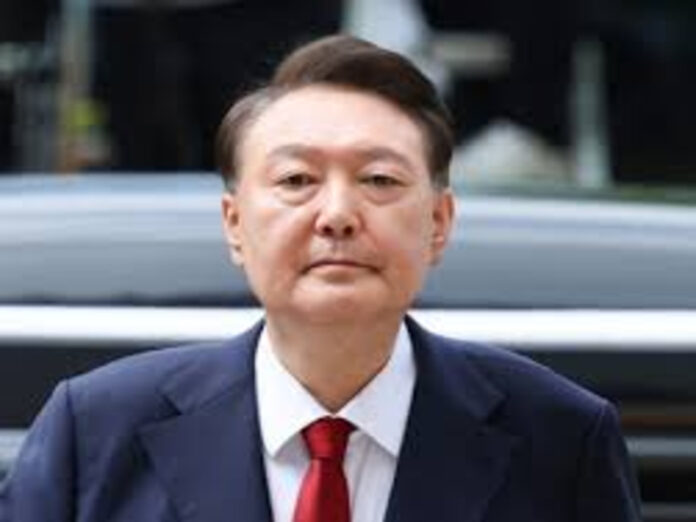
Court Finds December 2024 Martial-Law Bid Amounted To A Criminal Attempt To Subvert Constitutional Rule
Thursday, February 19, 2026, 4:00 P.M. ET. 5 Minute Read, By Jennifer Hodges, Plotical Editor: Englebrook Independent News,
SEOUL, KR.- A South Korean court on Thursday sentenced former President Yoon Suk Yeol to life in prison after finding him guilty of leading an insurrection tied to his failed attempt to impose martial law in December 2024, an explosive episode that lasted roughly six hours but plunged Asia’s fourth-largest economy into its most severe political crisis in decades.

The ruling, delivered at the Seoul Central District Court, concluded that Yoon’s deployment of military and police forces to the National Assembly was not a lawful exercise of emergency authority, but a criminal effort to subvert South Korea’s constitutional order and neutralize the legislature. The presiding judge ruled that the actions met the statutory definition of insurrection under South Korean criminal law.
The Events Of December 3, 2024;
The conviction centers on the night of December 3, 2024, when Yoon abruptly declared martial law amid escalating political confrontation with an opposition-controlled National Assembly.
According to court findings, the martial-law proclamation asserted extraordinary powers, including the suspension of political activity, expanded control over the media, censorship of publications, and the authority to make arrests without judicial warrants. These measures immediately evoked comparisons to South Korea’s authoritarian era and triggered widespread alarm among lawmakers, civil society, and the public.
Prosecutors argued, and the court agreed, that the declaration was not motivated by an imminent national emergency, but by Yoon’s desire to overcome legislative resistance through coercive force rather than constitutional governance.
Troop Deployment And Legislative Paralysis;
Central to the court’s ruling was the deployment of armed troops and police units to the National Assembly building in Seoul.
Evidence presented during the trial showed that security forces were positioned to restrict access to lawmakers, prevent legislative proceedings, and enable the arrest of key political figures. The court found that these actions constituted an attempt to paralyze the legislature and dismantle democratic checks on executive power.
In its written judgment, the court stated that ordering armed forces into parliament for the purpose of obstructing elected officials “constitutes an act of insurrection aimed at overthrowing constitutional governance.”
The Six-Hour Crisis;
Despite the show of force, the martial-law decree unraveled quickly.
Lawmakers forced their way into the National Assembly despite military and police cordons and convened an emergency session. Within approximately six hours, the Assembly voted to revoke the decree, compelling its reversal and ending the immediate crisis.
While the decree itself was short-lived, the court emphasized that the duration did not diminish the gravity of the offense, noting that the constitutional violation was complete once armed force was used against the legislature.
Impeachment, Removal, And Criminal Prosecution;
The political consequences were swift.
On December 14, 2024, the National Assembly impeached Yoon, immediately suspending his presidential powers. Following months of legal review, South Korea’s Constitutional Court formally removed Yoon from office in April 2025, clearing the way for criminal prosecution and national elections to restore executive leadership.
Special prosecutors and military investigators subsequently built a comprehensive criminal case focusing on conspiracy, command responsibility, and unlawful use of armed force.
Sentencing Decision: Life Imprisonment;
Under South Korean law, leading an insurrection carries a potential sentence of either life imprisonment or death.
Prosecutors sought the death penalty, citing the unprecedented nature of a sitting president deploying troops against the legislature. The court ultimately imposed a life sentence, citing the “enormous social, political, and constitutional damage” caused by the martial-law attempt.
The court noted that Yoon showed no public remorse and declined to participate meaningfully in portions of the proceedings, factors considered aggravating, though insufficient to justify capital punishment.
Convictions Of Senior Officials;
The ruling extended beyond the former president.
Five senior military and police officials were convicted for their roles in executing the martial-law operation. Among them, former Defense Minister Kim Yong Hyun received a 30-year prison sentence after the court found he played a central role in planning the decree, mobilizing forces, and directing military counterintelligence to prepare arrests of 14 prominent political figures, including the National Assembly speaker and the sitting president at the time.
The court found that these coordinated actions demonstrated a clear conspiracy to disable civilian government through force.
Defense Arguments And Appeal Prospects;
Yoon consistently denied wrongdoing throughout the proceedings.
His defense argued that the president possesses constitutional authority to declare martial law and framed the action as a warning about legislative obstruction rather than an attempt to seize power. The court rejected this argument, ruling that emergency powers cannot be used to dismantle constitutional institutions.
Following the verdict, Yoon’s legal team characterized the decision as “predetermined” and indicated that an appeal is under consideration. Under South Korean law, the case may be reviewed by higher appellate courts, including the Supreme Court.
A Nation Still Divided;
The verdict capped a saga that has left South Korea deeply polarized.
Supporters and opponents of the former president gathered near the courthouse, underscoring the enduring political divide over whether the case represents a necessary defense of democracy or a politicized reckoning with a conservative leader.
Legal scholars and international observers have widely described the case as a defining test of South Korea’s democratic resilience, particularly the principle of civilian control over the military and the ability of constitutional institutions to respond to executive overreach.
Editor’s Note:
This article was written by Jennifer Hodges, Political Editor, and is based on contemporaneous reporting from Reuters, the Associated Press, and other reputable international news organizations published February 18–19, 2026. Court proceedings, appellate filings, and sentencing outcomes may evolve. Englebrook Independent News will update this report should an appeal be formally lodged, a sentence be modified, or additional defendants’ outcomes materially change.