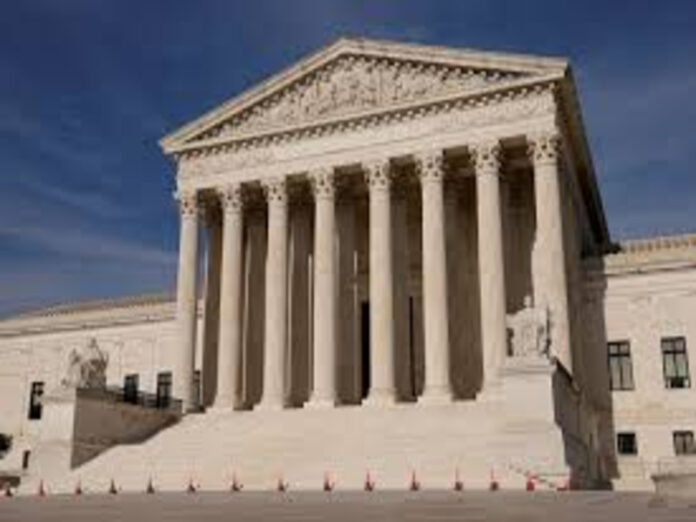
6–3 Ruling Finds IEEPA Does Not Clearly Authorize The President To Impose Sweeping Duties; Decision Upends Centerpiece Of Administration Trade Strategy
Friday, February 20, 2026, 11:30 A.M. ET. 5 Minute Read, By Jennifer Hodges, Political Editor: Englebrook Independent News,
WASHINGTON, DC.- The U.S. Supreme Court ruled Friday that President Donald Trump’s sweeping “global” tariffs, imposed under a declared national emergency and justified primarily through the International Emergency Economic Powers Act (IEEPA), exceeded the authority Congress granted the executive branch, delivering a major legal and economic setback to one of the administration’s most aggressive trade moves.

In a 6–3 decision in the consolidated cases Learning Resources, Inc. v. Trump and Trump v. V.O.S. Selections, Inc., the Court held that IEEPA “does not authorize the President to impose tariffs.” The Court vacated the district court’s decision in Learning Resources and ordered the case dismissed for lack of jurisdiction, while affirming the Federal Circuit’s judgment in V.O.S. Selections.
What The Court Struck Down, And Why It Matters;
The challenged tariffs arose from two emergency rationales described in the Court’s syllabus.
First were drug-trafficking emergency tariffs, imposed on Canada, Mexico, and China, which the administration argued were necessary to combat fentanyl trafficking and related national security threats.
Second were trade-deficit or “reciprocal” tariffs, which established a baseline duty of at least 10 percent on imports from U.S. trading partners, with higher rates for dozens of nations. Those tariffs were subsequently modified through a series of increases, reductions, suspensions, and country-specific adjustments.
The central legal question before the Court was whether IEEPA’s authorization allowing the President to “regulate … importation” during a declared national emergency includes the power to levy tariffs, which are taxes imposed on imported goods.
The Majority Opinion: Tariffs Are Taxes Reserved To Congress;
Chief Justice John Roberts authored the Court’s controlling opinion, joined in relevant parts by Justices Sonia Sotomayor, Elena Kagan, Neil Gorsuch, Amy Coney Barrett, and Ketanji Brown Jackson.
The majority grounded its analysis in the Constitution’s assignment of taxing authority to Congress, emphasizing that tariffs have historically been treated as a form of taxation. The Court noted that Article I of the Constitution vests Congress, not the President, with the power to impose “Taxes, Duties, Imposts and Excises.”
The Court rejected the government’s argument that IEEPA provides an implicit and expansive tariff authority. According to the majority, accepting that interpretation would permit the President to impose tariffs of unlimited scope, rate, and duration based solely on a declared emergency, an outcome the Court said would require clear and unmistakable authorization from Congress, which IEEPA does not provide.
The opinion also pointed to the broader framework of U.S. trade law, noting that when Congress intends to authorize tariff-setting, it does so explicitly through statutes containing defined triggers, procedural safeguards, and substantive limits. The Court contrasted IEEPA with other trade statutes commonly used by presidents, such as Section 232 and Section 301 authorities, which were not the basis of the global tariffs at issue.
A Divided Majority On Legal Reasoning;
While six Justices agreed on the outcome, the Court revealed internal divisions over the reasoning used to reach it.
Chief Justice Roberts’ opinion relied in part on the Court’s “major questions” doctrine, which requires clear congressional authorization when the executive branch asserts powers of vast economic and political significance.
Justice Elena Kagan, joined by Justices Sotomayor and Jackson, concurred in the judgment but emphasized that the case could be resolved using ordinary statutory interpretation alone, without invoking the major-questions framework.
Concurring Opinions Highlight Limits Of Emergency Authority;
Justice Neil Gorsuch wrote separately to warn against executive reliance on vague statutory language to justify sweeping policy changes. He argued that courts should be particularly cautious when the executive branch claims unprecedented authority based on broad or “cryptic” provisions.
Justice Amy Coney Barrett also filed a concurrence, framing the case as implicating a clear-statement principle rooted in Article I. She stressed that when an asserted executive power touches the core of Congress’s legislative authority, courts should demand explicit congressional approval.
Justice Ketanji Brown Jackson concurred in part and in the judgment, agreeing that IEEPA does not confer tariff authority. She added that legislative history surrounding IEEPA and its predecessor, the Trading with the Enemy Act, further supports the conclusion that Congress never intended to allow unilateral tariff-setting through emergency economic powers.
The Dissents: A Broader View Of Presidential Trade Authority;
Three Justices dissented from the Court’s ruling.
Justice Clarence Thomas argued that regulation of foreign commerce and national security traditionally affords the political branches broader discretion. He emphasized historical practices in which sovereigns have used import duties as tools of foreign policy and national defense.
Justice Brett Kavanaugh, joined by Justices Thomas and Samuel Alito, contended that IEEPA’s authorization to “regulate … importation” naturally includes traditional regulatory tools such as tariffs, particularly during national emergencies. He cited historical precedents, including President Richard Nixon’s 1971 across-the-board import tariffs under IEEPA’s predecessor statute, as evidence that Congress understood tariffs to fall within emergency economic powers.
Immediate Consequences And Future Battles;
The ruling invalidates the administration’s most expansive tariff program built on emergency declarations under IEEPA, removing a fast-acting mechanism the White House argued was necessary to address drug trafficking and persistent trade imbalances.
The decision does not bar future tariffs outright but forces the executive branch to rely on other statutory authorities that typically require formal investigations, detailed findings, and greater procedural safeguards, potentially shifting trade policy disputes from emergency declarations to administrative and congressional processes.
Legal experts also expect further litigation over remedies, including whether importers may seek refunds for duties paid under the invalidated tariff regime, questions likely to be addressed in the Court of International Trade and related federal courts.
Editor’s Note:
This breaking report was written by Jennifer Hodges, Political Editor, and is based on the U.S. Supreme Court’s slip opinion released Friday, February 20, 2026, in Learning Resources, Inc. v. Trump (No. 24–1287) and Trump v. V.O.S. Selections, Inc. (No. 25–250), including the syllabus and separate opinions authored by individual Justices. Slip opinions are subject to formal revision before publication in the official United States Reports. Englebrook Independent News will update this coverage should any substantive changes occur.