President Cites Falling Inflation, Tougher Border Enforcement, Restored Safety & National Pride, While Rebuking Iran & Democratic Opposition
Wednesday, February 25, 2026, 8:30 A.M. ET. 6 Minute Read, By Jennifer Hodges, Political Editor: Englebrook Independent News,
WASHINGTON, DC.- President Donald J. Trump delivered his State of the Union address Tuesday night, February 24, 2026, declaring that the nation is “back” and entering what he described as a new “golden age,” defined by economic growth, restored national pride, and significant policy achievements in his second term.
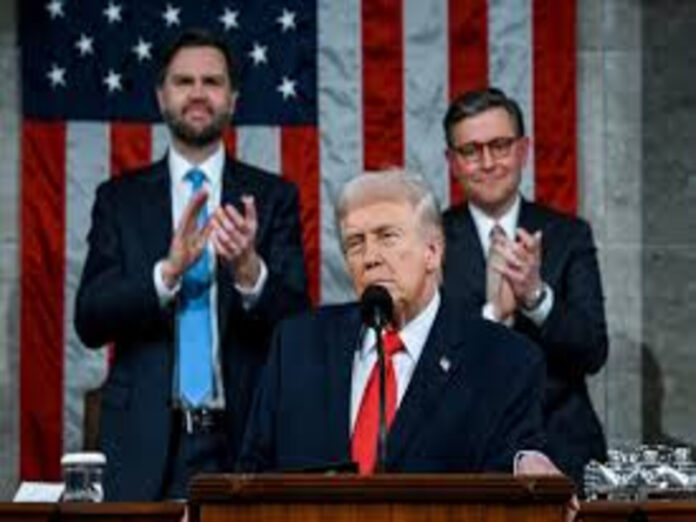
Addressing a joint session of Congress with Speaker Mike Johnson and Vice President J.D. Vance behind him, Trump highlighted a year of victories on inflation, border security, public safety, and law enforcement, and cast a stark contrast with what he called “sad obstruction and spectacle” from Democrats.

Meanwhile, Trump also used the address to confront growing international tensions, particularly with Iran, characterizing Tehran as a destabilizing force and outlining his administration’s uncompromising stance against its nuclear ambitions.
The speech was marked by both enthusiastic applause and intense political division, with visible Democratic protests inside the chamber, coordinated walkouts, and competing counter-events outside the Capitol, actions Republicans criticized as disrespectful to the presidency, the institution of Congress, and the American people.
“Our Nation Is Back”: Trump’s Case For A First-Year Turnaround;
From his opening remarks, President Trump framed the State of the Union around the idea that the United States was recovering from years of economic strain and weakened security, urging lawmakers to embrace national unity and renewed confidence in American leadership.
He credited a broad set of domestic policy initiatives with lowering costs for families, bolstering energy independence, restoring border enforcement, and reversing what he described as a dangerous erosion of law and order.
Economy And Inflation;
Trump asserted that inflation “plummeted” during his first year back in office, citing easing consumer prices, declining mortgage costs, and renewed investor confidence. He pointed to record levels of domestic and foreign investment commitments as evidence that businesses were once again betting on America.
The White House’s first-year summary emphasized deregulation, expanded domestic energy production, and tax stability as central contributors to easing cost-of-living pressures and stabilizing the economy.
Energy And Cost-Of-Living;
A central pillar of Trump’s economic message was expanded U.S. energy production. Repeating his familiar refrain, “drill, baby, drill,” the President argued that energy independence directly reduced fuel costs, strengthened national security, and insulated American families from global market shocks.
Immigration Enforcement And Border Security;
The President described border security as one of the defining achievements of his first year, claiming illegal crossings had been effectively halted for months and that fentanyl trafficking at the southern border had dropped sharply.
The administration has pointed to increased removals, arrests, and enforcement actions, along with expanded cooperation between federal agencies, as evidence of a decisive break from prior immigration policies.
Crime And Public Safety;
Trump declared that the nation experienced what he described as the “single largest decline in the murder rate in recorded history,” attributing the trend to tougher enforcement, support for law enforcement officers, and a rejection of progressive criminal-justice policies he said had emboldened violent offenders.
Trump’s Foreign Policy: Strong Words For Iran;
Turning to national security and foreign policy, President Trump issued pointed warnings directed at Iran, framing Tehran as a persistent threat to global stability.
Trump accused the Iranian regime of attempting to rebuild its nuclear weapons program and reiterated that the United States would never allow Iran, which he labeled “the world’s leading state sponsor of terror,” to obtain a nuclear weapon.
While stating that he preferred a diplomatic resolution, Trump warned that Iran’s development of long-range missile capabilities and continued defiance of international norms would not be tolerated. He said negotiations could only succeed if Iran offered what he called an unequivocal and verifiable abandonment of nuclear ambitions.
The President emphasized that American strength, deterrence, and resolve, not appeasement, would guide U.S. policy in the Middle East.
Policy Agenda: What Trump Asked Congress To Do Next;
The address also served as a legislative roadmap, with Trump urging Congress to advance a slate of Republican priorities, including:
- A “Safe America Act” elections package, calling for voter ID requirements, proof of citizenship, and limits on mass mail-in voting.
- Expanded enforcement against sanctuary jurisdictions, aimed at preventing states and cities from obstructing federal immigration law.
- “Trump Accounts”, tax-advantaged investment accounts for children designed to encourage long-term family wealth.
- Worker-focused tax relief, including proposals for “no tax on tips” and “no tax on overtime.”
- Public-safety legislation is tied to commercial driver licensing standards and legal compliance.
Trump challenged lawmakers to stand openly for what he called citizen-first governance, emphasizing that the federal government’s primary responsibility is to protect Americans.
Democrats’ Disruptions, Protests, And Boycotts;
While Republicans repeatedly rose to applause, Democrats used the nationally televised address to stage a coordinated, highly visible protest.
Approximately 70 Democratic lawmakers boycotted the State of the Union altogether, refusing to attend the address and instead participating in counter-events and demonstrations. Others who did attend remained seated, held protest signs, shouted interruptions, or walked out during the President’s remarks.
Among the most notable incidents:
- Rep. Al Green (D–Texas) was escorted out after displaying a protest sign during the speech.
- Large-scale Democratic absences from the House chamber signaled an organized boycott.
- Heckling and interruptions during portions of the address addressing immigration and national security.
Outside the Capitol, Democratic lawmakers and allied activist groups staged alternative “People’s State of the Union” events, emphasizing opposition to Trump’s agenda.
Republicans countered that the disruptions underscored what they described as a Democratic Party more focused on political theater than addressing inflation, border security, and rising public concern over crime.
Record-Length Address, And Disputes Over Data;
Trump’s nearly 1-hour and 48-minute speech was widely described as the longest State of the Union address in modern history.
As expected, independent fact-checking organizations scrutinized specific claims, particularly those related to economic comparisons and trend interpretation. The White House maintained that its metrics accurately reflected improved conditions during Trump’s first year back in office.
Conclusion: A Defining Contrast Heading Into The Next Year;
In a chamber divided between standing ovations and deliberate protest, President Trump used the State of the Union to draw a sharp contrast: Republicans advancing an agenda of enforcement, energy abundance, and economic growth, and Democrats responding with boycotts, disruptions, and symbolic opposition.
The administration has indicated it will press Congress aggressively in the months ahead to codify border security measures, expand tax relief, and lock in policies it believes resonate with voters nationwide.
Whether Democrats engage on those proposals or continue to emphasize protest may shape not only the legislative calendar but the broader political climate moving forward.
Editor’s Note:
This article was written by Jennifer Hodges, Political Editor, and summarizes President Trump’s February 24, 2026, State of the Union address using contemporaneous reporting and the official speech transcript. Claims of accomplishments are attributed directly to statements made by the President and the White House. Where independent fact-checking organizations have disputed or contextualized specific assertions, particularly on economic or foreign-policy metrics, that context is included to maintain transparency and editorial integrity.