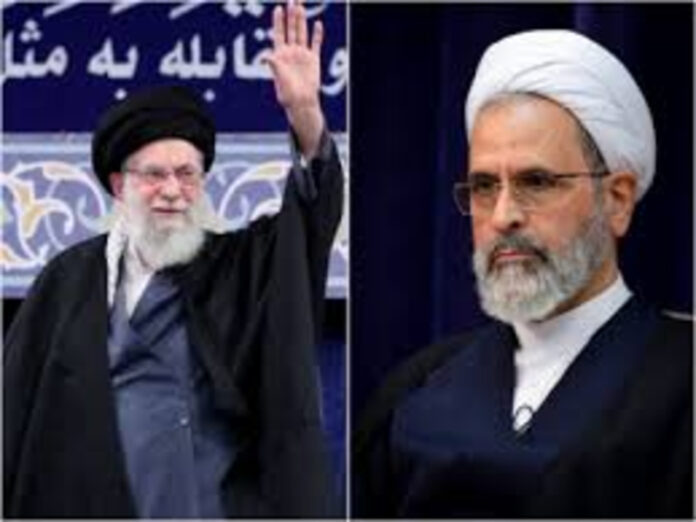
Leadership Decapitation Does Not Guarantee A Swift End To Conflict As Iran Faces Succession & Regional Fallout
Sunday, March 1, 2026, 10:00 A.M. ET. 4 Minute Read, By Jennifer Hodges, Political Editor: Englebrook Independent News,
WASHINGTON, DC.- The reported death of Iran’s Supreme Leader, Ali Khamenei, following an Israeli strike on his Tehran compound, represents one of the most consequential geopolitical developments in the Middle East since the 1979 Islamic Revolution.
But if history is a guide, the removal of a single leader, even one as powerful as Khamenei, does not automatically end a war.

Instead, it often marks the beginning of a new and unpredictable phase.
A System Built To Survive The Man;
Khamenei’s authority was vast. As Supreme Leader, he controlled Iran’s military command structure, intelligence services, judiciary, state broadcasting, and foreign policy apparatus. Yet Iran’s power is institutional, not purely personal.
The Islamic Republic operates through layered structures that remain intact:
- The Islamic Revolutionary Guard Corps (IRGC)
- The regular Iranian Armed Forces
- The Assembly of Experts
- The Guardian Council
- Extensive regional proxy networks
Even in the absence of Khamenei, these institutions continue to function.
The IRGC, in particular, is economically entrenched, politically powerful, and militarily sophisticated, and is likely to play a decisive role in stabilizing or reshaping the regime’s leadership transition.
The Succession Question;
Under Iran’s constitution, the Assembly of Experts is responsible for appointing a new Supreme Leader. Historically, this process has been tightly managed behind closed doors.
However, the current moment is unprecedented. Khamenei ruled for 36 years, consolidating authority in a way that left few alternative power centers capable of operating independently.
Three plausible succession pathways now emerge:
Rapid Clerical Appointment – The Assembly selects a pre-vetted hardline successor, signaling continuity and projecting stability.
IRGC Consolidation – Military leadership exerts dominant influence, potentially steering Iran toward a more overtly security-driven governance model.
Internal Power Struggle – Competing factions within the clerical and military elites contest control, creating temporary instability.
The speed and clarity of this transition will heavily influence whether the conflict de-escalates or intensifies.
Why Wars Rarely End With A Leader’s Death;
History offers caution.
Leadership decapitation can:
- Harden domestic resolve.
- Trigger retaliatory nationalism.
- Empower hardliners.
- Fragment command structures.
- Expand proxy operations.
Iran’s regional partners, including Hezbollah in Lebanon, militias in Iraq and Syria, and Houthi forces in Yemen, possess operational autonomy. Even in the absence of centralized command, retaliatory actions could continue across multiple fronts.
This creates the risk of a distributed conflict rather than a contained one.
The Israeli And U.S. Calculus;
For Israel, eliminating a leader long perceived as an existential threat may represent a strategic objective achieved. However, Israeli defense planners must now prepare for asymmetric retaliation.
For the United States, the calculus is more complex. Direct involvement could deter escalation or widen the theater of conflict.
Washington must balance:
- Regional base security
- Energy market stability
- NATO alliance positioning
- Broader geopolitical implications involving Russia and China
Oil markets have already shown volatility amid uncertainty over Persian Gulf shipping lanes.
Scenarios For The Days Ahead;
Several near-term trajectories appear plausible:
1. Controlled Escalation Followed by Ceasefire
Missile exchanges intensify briefly before diplomatic backchannels produce a containment agreement.
2. Sustained Proxy Conflict
Iran leverages regional networks to sustain prolonged indirect retaliation without a direct state-to-state war.
3. Internal Consolidation Before External Action
Tehran prioritizes regime stability, delaying major retaliation while the leadership consolidates power.
4. Multi-Front Expansion
Retaliatory strikes widen across Lebanon, Syria, Iraq, and Gulf states, drawing in additional powers.
The likelihood of a conflict ending “within days” appears low. Institutionalized military and ideological systems do not dissolve with the death of a single individual, even one as central as Khamenei.
A Regional Inflection Point;
For supporters within Iran’s conservative establishment, Khamenei embodied revolutionary continuity and resistance to Western influence. For critics, he represented entrenched authoritarianism and regional destabilization.
His death, if fully confirmed by Tehran, may ultimately reshape the Islamic Republic’s trajectory.
But in the immediate term, the region faces volatility, not resolution.
The coming 72 hours will likely determine whether this moment becomes the beginning of de-escalation or the start of a more complex and dangerous chapter in Middle Eastern geopolitics.
Editor’s Note:
This geopolitical analysis was written by Jennifer Hodges, Political Editor, and is based on confirmed reports regarding the strike on Ayatollah Ali Khamenei’s compound and established institutional structures within the Islamic Republic of Iran. As succession developments unfold and regional responses clarify, Englebrook Independent News will continue providing verified updates and strategic analysis.