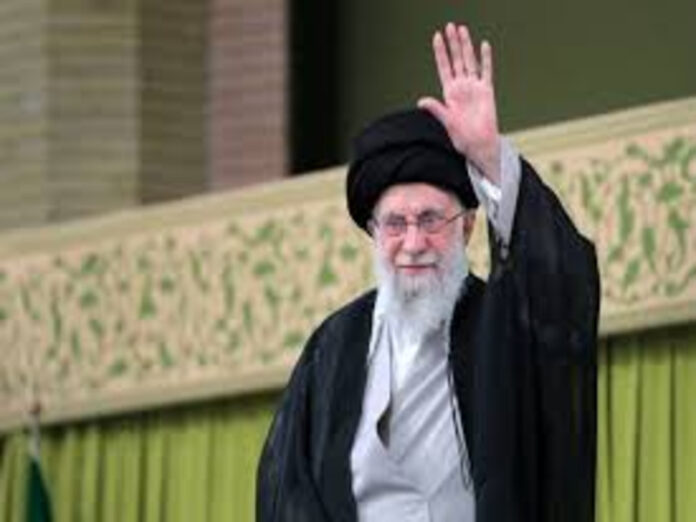
Close U.S.–Israeli Coordination Targeted Tehran Leadership Gathering, Officials Say
Monday, March 2, 2026, 8:15 A.M. ET. 5 Minute Read, By Jennifer Hodges, Political Editor: Englebrook Independent News,
WASHINGTON, DC.- The killing of Iran’s Supreme Leader, Ayatollah Ali Khamenei, came after months of close intelligence coordination between the United States and Israel, culminating in a precisely timed strike on a leadership compound in central Tehran, according to multiple individuals familiar with the operation.
U.S. intelligence officials, speaking on condition of anonymity due to the sensitivity of the matter, said the Central Intelligence Agency had been tracking Khamenei’s movements for months. Analysts reportedly identified patterns in his security rotations, travel habits, and meeting schedules, gradually increasing confidence in pinpointing his location during high-level gatherings.

That intelligence reportedly converged late last week when the agency intercepted and confirmed plans for a Saturday morning meeting of senior Iranian political and military leadership at a secure compound in the heart of Tehran. Most critically, sources said, the CIA determined that the Supreme Leader himself would attend.
The discovery presented what one U.S. official described as “a narrow but decisive window.”
Adjusted Timing Of The Strike;
According to officials familiar with the planning, the United States and Israel had already been preparing for coordinated action amid escalating tensions over Iran’s nuclear program and regional proxy activity. However, once confirmation of Khamenei’s attendance at the leadership meeting was received, operational timelines were adjusted.
Israeli defense planners, working in concert with U.S. intelligence counterparts, advanced elements of the strike to capitalize on the intelligence breakthrough, sources said.
The strike was carried out by Israeli forces, though American officials acknowledged that U.S. intelligence played a critical role in target verification and timing.
An Israeli official confirmed that the compound was reduced to rubble in the attack. Satellite imagery reviewed by Western analysts appears to show extensive structural destruction consistent with precision-guided munitions.
Multiple senior Iranian officials were reportedly present at the meeting. While Tehran has not released a full accounting of casualties, Iranian state media acknowledged “significant leadership losses” and vowed retaliation.
Months of Tracking;
Intelligence officials described the operation as the culmination of sustained surveillance, signals interception, human-source reporting, and pattern-of-life analysis.
Khamenei, who ruled Iran for more than three decades, maintained a notoriously tight security apparatus. As Supreme Leader, he exercised ultimate authority over Iran’s military, judiciary, state broadcasting, and nuclear policy.
Over the past year, U.S. intelligence agencies had intensified monitoring of Iranian command structures amid mounting confrontations involving Israel, Iranian-backed militias, and U.S. assets in the region.
Officials familiar with the intelligence assessment said analysts gained increasing clarity about how and when Khamenei convened top leadership sessions, particularly during periods of heightened geopolitical tension.
When confirmation came that the Supreme Leader would attend the Saturday session, officials described the intelligence as “actionable with high confidence.”
Strategic Objectives;
The decision to move forward with the strike reflected what one senior U.S. official described as a “strategic calculus” aimed at disrupting Iran’s command-and-control structure at the outset of a broader confrontation.
The elimination of Khamenei and other senior figures was viewed as a potential way to destabilize decision-making chains and delay coordinated retaliation, according to officials briefed on the operation.
Khamenei, 86, had served as Iran’s Supreme Leader since 1989, succeeding Ruhollah Khomeini. During his tenure, he oversaw Iran’s expansion of ballistic missile capabilities, its support for regional proxy forces, and its steady advancement of uranium enrichment activities.
Western governments had long accused Iran of pursuing nuclear weapons capability, an allegation Tehran consistently denied.
Regional And Global Implications;
The strike marks one of the most consequential targeted operations in modern Middle Eastern history.
Iranian officials have threatened severe retaliation, including potential strikes against U.S. bases in the region and expanded attacks through proxy forces. The U.S. State Department has already issued travel advisories and elevated threat levels at diplomatic facilities throughout the Middle East.
Defense analysts caution that while the removal of Iran’s top leadership could create temporary disruption, it may also galvanize hardline factions within Tehran’s political structure.
The Iranian constitution provides for succession through the Assembly of Experts, but the sudden and violent removal of a Supreme Leader introduces uncertainty into a system built around centralized authority.
Meanwhile, U.S. officials have declined to publicly detail the scope of intelligence cooperation with Israel. However, multiple current and former officials describe the intelligence-sharing relationship between the two countries as among the closest in the world.
“This was not an improvised operation,” one official familiar with the planning said. “It was the product of sustained intelligence development and coordination.”
A Defining Moment;
The killing of Ayatollah Khamenei represents a defining moment in the long-running shadow conflict between Israel and Iran, and underscores the extent to which intelligence operations now shape battlefield outcomes in real time.
As Tehran weighs its response, global markets and regional governments remain on alert for signs of escalation.
Whether the strike ushers in de-escalation through deterrence or accelerates a broader regional war remains uncertain.
Editor’s Note:
This article was written by Jennifer Hodges, Political Editor, and is based on information provided by U.S. and Israeli officials familiar with the operation. Certain operational details remain classified. Englebrook Independent News will continue to verify developments as additional confirmed information becomes available.