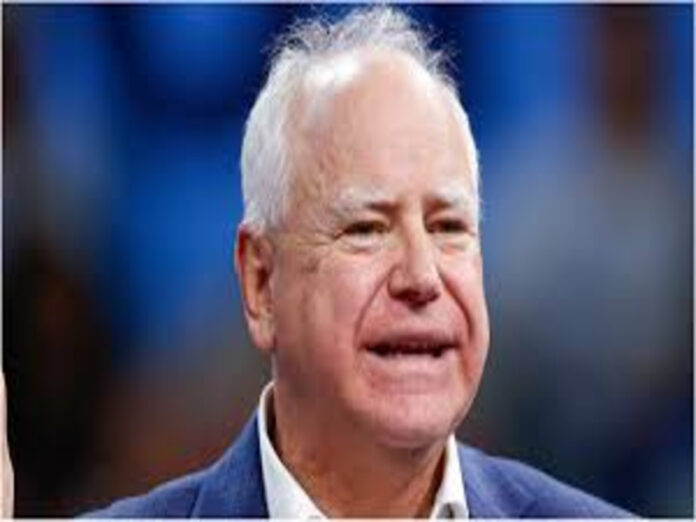
The Majority Of Defendants Are Somali Immigrants; Federal Probe Examines Whether Stolen Funds Reached Al-Shabaab Terrorists
Tuesday, December 2, 2025, 8:00 A.M. ET. 8 Minute Read, By Jennifer Hodges, Political Editor: Englebrook Independent News,
SAINT PAUL, MN.- The political firestorm surrounding Minnesota Governor Tim Walz intensified dramatically this week as fresh revelations, federal investigations, and state-employee whistleblower accounts point to a sweeping breakdown of oversight that allowed nearly $1 billion in fraud to flourish across multiple taxpayer-funded programs. Federal prosecutors say the majority of individuals charged and convicted in the sprawling scheme are Somali immigrants or Somali-Americans living in the Minneapolis area, a demographic detail now at the center of both political debate and federal scrutiny.

The scandal, initially believed to involve several hundred million dollars, now encompasses layers of COVID-relief abuse, housing-program fraud, senior-care exploitation, and nonprofit corruption. The U.S. Attorney’s Office for the District of Minnesota has charged or indicted 86 people, with over 59 convictions already secured. Some defendants, investigators say, funneled significant sums overseas through informal money-transfer channels. The U.S. Treasury Department is now probing whether some of those funds ultimately reached Al-Shabaab, the Somalia-based terrorist organization responsible for dozens of attacks in East Africa and designated by the U.S. government as a foreign terrorist group.
What began as a story about mismanaged COVID programs has evolved into a major integrity crisis for the state government and one that threatens to reshape Minnesota’s political landscape heading into the 2026 gubernatorial race.
Whistleblowers Say Walz Ignored Years Of Warnings;
According to hundreds of Minnesota Department of Human Services (HHS) workers, the Walz administration repeatedly failed to act on detailed warnings about suspicious actors who were exploiting state and federal programs, long before the scandal became public.
These state workers, over 400 of them, issued a rare coordinated statement earlier this year accusing the governor of presiding over a “culture of indifference” toward fraud within the agencies responsible for distributing housing subsidies, child-nutrition aid, and adult-care reimbursements.
“We let Tim Walz know of fraud early on, hoping for a partnership in stopping it,” the group wrote. “Instead, we got retaliation, monitoring, intimidation, and a deliberate effort to discredit our findings.”
Multiple former agency employees report being sidelined, demoted, or pressured to soften fraud reports. Some were allegedly told not to put certain warnings in writing. Others described being treated as internal “problems” for raising concerns that should have triggered immediate oversight reform.
In one particularly troubling revelation, some whistleblower correspondence was quietly forwarded to the Kamala Harris campaign during the 2024 presidential cycle, a move employees say they made only after the Walz administration repeatedly ignored them. The Harris campaign has not commented on the materials or whether any action was taken.
According to internal memos shared publicly by whistleblowers, program auditors documented irregularities as early as 2019 in several nonprofit organizations that later became central players in the COVID-relief fraud investigations. Yet, employees say, the Walz administration failed to suspend contracts, conduct deeper audits, or intervene in any meaningful way.
A Long List of Fraud Schemes, Nearly $1 Billion Lost;
Federal prosecutors say the fraud took many forms, each targeting a program designed to support vulnerable Minnesotans.

COVID-Era Child Nutrition Fraud, Over $300 Million Lost:
The widely publicized Feeding Our Future scheme involved fake meal sites, fabricated attendance numbers, and inflated reimbursement forms submitted to the state. Some organizations claimed to be feeding thousands of children per day, numbers that defied logistical reality.
Housing Stability Services Fraud:
Under Medicaid’s Housing Stability Services, nonprofits were reimbursed for assisting homeless or at-risk individuals. Investigators say several groups billed for services never performed, used fake client files, and diverted funds to personal accounts.
Senior-Care and Adult-Day-Service Fraud:
In programs intended for elderly Minnesotans, investigators discovered nonexistent clients, ghost visits, inflated billing, and sham service logs. Some operators billed the state for hundreds of hours of services that never occurred.
Nonprofit Grant Diversion:
Organizations receiving community-aid grants created layers of shell companies to disguise payments, shift funds into private accounts, or move cash overseas.
These combined operations, each large in its own right, now total around $1 billion, according to updated federal estimates.

The Majority Of Defendants Are Somali Immigrants Or Somali-Americans;
While prosecutors emphasize that the crimes were committed by individuals, not an entire community, the demographic pattern is unmistakable: most defendants charged in the Minnesota fraud schemes are Somali immigrants or Somali-Americans living in Minneapolis.
Many of the implicated organizations were Somali-run nonprofits, Somali-owned consulting groups, or Somali-staffed food-aid subcontractors. The combination of close-knit business networks, informal financial channels, and the rapid expansion of COVID-related assistance programs created an environment where criminal enterprises could grow unchecked.
Federal investigators noted that several defendants used informal money-transfer systems common in the Somali diaspora, complicating efforts to trace the funds.

Treasury Opens Terror-Financing Probe Into Possible Al-Shabaab Links;
The U.S. Treasury Department’s Terrorism and Financial Intelligence division has launched one of the most politically sensitive aspects of the scandal: determining whether any of the stolen Minnesota funds were routed, knowingly or unknowingly, to al-Shabaab, the Somalia-based terror group.
Investigators tracking overseas remittances have flagged:
- Unusually large transfers.
- Sudden changes in remittance patterns.
- Potential use of hawala-style networks.
- Transactions that corresponded with the fraud timeline.
While Treasury officials stress that no terrorism-financing indictments have yet been issued, the evidence has been compelling enough to warrant a full federal inquiry.
If even a fraction of the stolen funds contributed to terrorist financing, the scandal would expand beyond fiscal mismanagement into national-security failure.
Walz Attempts to Shift Blame, “This Was Federal Negligence;”
Gov. Walz has responded by arguing that the fraud stemmed primarily from the structure of emergency federal programs during the pandemic.
He has claimed that the Trump administration’s COVID relief framework lacked internal “guardrails,” making fraud easier. But federal prosecutors and state employees dispute this argument, noting that:
- The fraud occurred almost entirely after Trump left office.
- Walz’s own agencies were responsible for oversight and failed repeatedly.
- Whistleblowers raised alarms years before and during the fraud.
Critics say the governor is attempting to redirect blame for a scandal that unfolded under his administration, not Washington’s.
One HHS employee put it bluntly:
“Walz is trying to dump this on Trump, but the fraud happened when Trump wasn’t president. He ignored every warning we gave him.”
The governor’s office has not responded directly to these specific accusations.

Trump: “Walz Is Incompetent, A Total Dope”
Former President Donald Trump has used the scandal to attack Walz’s leadership, calling him “incompetent” and accusing him of allowing Minnesota to become a “hub of fraudulent money laundering.”
In remarks last week, Trump said:
“Somalians are ripping us off for a lot of money, and Walz did nothing. A tremendous amount of money is going back to Somalia.”
Walz condemned Trump’s comments as “lazy bigotry,” but the exchange fueled national headlines and cemented the scandal as a major political liability for the governor.
Political Fallout: Walz’s Future On The Line;
With the Treasury investigation underway, federal indictments continuing, and whistleblower accounts gaining traction, the political environment in Minnesota has shifted sharply.
Voter Frustration Surges:
Minnesotans, especially seniors, suburban families, and middle-class taxpayers, are expressing growing anger at the scale of the fraud and the perception that state leaders failed to prevent it.
Republicans See A Path To Unseat Walz:
GOP strategists are already framing the 2026 race around “integrity, accountability, and protection of taxpayer funds.” The fraud scandal gives them concrete ammunition.
Democrats Quietly Concerned:
Privately, some Democratic operatives admit the scandal’s timing is disastrous, arguing that Walz’s response “lacked urgency” and left the party “vulnerable.”
If the Treasury probe produces further evidence, especially links to terrorist financing, multiple analysts believe Walz could face a catastrophic erosion of public support.
A Crisis Of Oversight, Competence, And Trust;
For many Minnesotans, the details of the fraud are less shocking than the length of time it was allowed to continue. Programs intended for children, seniors, the homeless, and vulnerable adults were exploited on an enormous scale, often in plain sight.
The scandal reveals systemic weaknesses:
- Auditing protocols were ignored.
- Whistleblowers silenced.
- Compliant contractors rubber-stamped.
- Oversight offices starved of authority.
- Politically connected nonprofits shielded from scrutiny.
Even with the ongoing prosecutions, many questions remain:
- Why were so many red flags dismissed?
- Why weren’t problematic nonprofits suspended sooner?
- Why did the Walz administration resist deeper audits?
- How much money ultimately left the country?
- And how much, if any, may have reached Al-Shabaab?
Until those questions are answered, the cloud over Minnesota’s government will likely continue to grow.
Editor’s Note:
This article draws on publicly available information from the U.S. Attorney’s Office for the District of Minnesota; press reporting by FOX9 Minneapolis, KARE11, the Star Tribune, FOX News, Reuters, and Congressional press releases; statements from Minnesota HHS whistleblowers; and public remarks made by Minnesota Governor Tim Walz and former President Donald Trump. Allegations involving possible money flows to Al-Shabaab are based on reporting of ongoing U.S. Treasury Department investigations. No terrorism-financing indictments have been filed as of publication time.