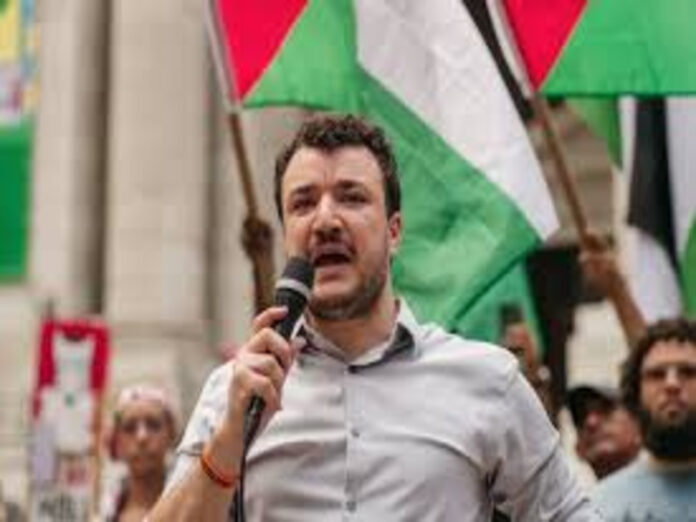
From Columbia’s Gaza Encampment To ICE Detention, And A Political Battle Over Power, Speech, And The Limits Of U.S. Immigration Law
Friday, December 5, 2025, 12:00 A.M. ET. 8 Minute Read, Op-Ed, By Jennifer Hodges, Political Editor: Englebrook Independent News,
MANHATTAN, NY.- When federal immigration agents entered a Columbia University apartment building on the night of March 8, 2025, they were not simply detaining one graduate student. They were setting a precedent that would ignite a firestorm over free speech, political dissent, immigration power, and what the U.S. government now defines as “antisemitism.”

The man taken into custody, Mahmoud Khalil, is a Syrian-born Palestinian of Algerian citizenship who grew up in a refugee camp and rose to prominence as a principal student negotiator, organizer, and spokesperson during the 2024 Gaza Solidarity Encampment at Columbia University. His high-profile activism made him a symbolic figure, celebrated by supporters as a disciplined advocate for Palestinian rights, and condemned by critics as a dangerous ideological agitator.
Today, nearly nine months after his arrest, Americans still ask: Where is Mahmoud Khalil, legally, politically, and physically? And what role did the U.S. State Department, operating under Secretary of State Marco Rubio, play in the revocation of his visa and permanent resident green card?
This op-ed examines the record in detail, drawing on publicly available court documents, human rights reports, and verified reporting from reputable outlets.
From Refugee Camp To Columbia University;
Public records establish that Khalil was born in 1995 in a Palestinian refugee camp in Damascus, Syria. As a teenager, he participated in peaceful demonstrations during the Syrian uprising before fleeing the country in 2013.
He later earned a degree in computer science from the Lebanese American University in Beirut. Colleagues from international development circles say he worked on analysis and language support for a British-government-funded scholarship program serving Syrian students. Nothing in the public record links him to radicalism or violence during this period.
In 2022, Khalil arrived in the United States to pursue a Master of Public Administration at Columbia University’s School of International and Public Affairs (SIPA). He completed his degree in December 2024 and was approved for lawful permanent resident status, a U.S. green card, that same year.
His academic career was largely uncontroversial until the Israel-Gaza war protests seized campuses nationwide. It was at Columbia, amid one of the most politically charged student movements in decades, that Khalil emerged as a central figure.
Leading the Columbia Encampment, And The National Backlash;
In the spring of 2024, as the Columbia protests intensified, Khalil became one of the most visible representatives of the Gaza Solidarity Encampment and the Columbia University Apartheid Divest (CUAD) coalition. Administrators, including some who disagreed with the protests, privately described him as a “disciplined” and “principled” negotiator who helped prevent clashes and ensure communication channels remained open.
But politically, the environment was combustible.
President Trump, members of Congress, and several major pro-Israel advocacy groups accused Columbia protesters of antisemitism, echoing claims that the campus movement aligned with Hamas ideology. These objections, amplified exponentially by media outlets and online activists, quickly focused on Khalil himself.
Khalil has consistently argued that his activism sought equality for all people, explicitly rejecting antisemitism. He stated repeatedly that Jewish and Palestinian liberation were “intertwined” and insisted that discrimination against Jews had no place in the movement.
Even so, outside organizations, including doxxing sites such as Canary Mission and the extremist Jewish nationalist group Betar, circulated Khalil’s private information, labeled him a terrorist sympathizer, and promoted calls for his deportation. Some of these materials were later referenced indirectly in federal immigration filings, raising concerns that political pressure and surveillance influenced the government’s actions.
No U.S. court or academic inquiry has found Khalil guilty of antisemitic conduct. The evidence against him centers almost entirely on his involvement in the high-profile protests, not on violent or discriminatory behavior.
The U.N. Question And The State Department’s Role;
The most significant legal escalation came when the U.S. State Department, operating under the authority of Secretary of State Marco Rubio, revoked Khalil’s student visa and later moved to invalidate his permanent resident status.
Here is what the documented public record shows:
1. State Department Authority Under Secretary Rubio.
- The U.S. State Department possesses broad power to revoke visas and to recommend revocation of permanent resident status when foreign-policy concerns are cited.
- Under Secretary of State Marco Rubio, the Department invoked a Cold War–era statute allowing exclusion or deportation if a noncitizen’s presence is deemed to cause “serious adverse foreign policy consequences.”
2. Visa Revocation.
- In early March 2025, the State Department notified ICE that Khalil’s student visa had been revoked under foreign-policy authority.
- Agents attempted to classify him as a visa violator until they learned he had become a lawful permanent resident, requiring a more substantial process.
3. Green Card Challenge.
- The State Department’s revocation action was accompanied by a determination that Khalil’s lawful permanent resident status should be rescinded, citing alleged nondisclosures on his immigration forms.
- The most notable allegation was that Khalil failed to disclose previous work associated with UNRWA, the United Nations Relief and Works Agency for Palestine Refugees.
Khalil denies any wrongdoing, stating that he provided accurate information and that any omissions were unintentional clerical issues. U.N. human-rights experts have since issued formal statements defending him and criticizing the U.S. government’s actions.
It is important to note that visa revocation by the State Department is not a criminal finding; it is an administrative action subject to challenge. Khalil’s legal team contends that the revocation served as a political mechanism to target a prominent Palestinian activist.
The Night Of The Arrest;
On March 8, 2025, ICE agents followed Khalil and his pregnant wife into their Columbia apartment building. According to court filings:
- Agents identified him and told his wife she would be arrested if she refused to leave.
- They acknowledged they were acting because the State Department had revoked his visa.
- When informed he was a permanent resident, not merely a visa holder, they claimed his green card had also been invalidated.
The agents did not present a judicial warrant. Instead, they used an internal administrative warrant later described by experts as insufficient for entry or seizure.
ICE transferred Khalil to the LaSalle Detention Facility in Jena, Louisiana, far from family, legal counsel, and the university community.
He remained in custody for 104 days. He missed the birth of his daughter after ICE denied a compassionate release request.
Courts Push Back, And Then Complicate The Case;
In June 2025, U.S. District Judge Michael Farbiarz ruled that the government’s reliance on foreign-policy deportation powers against Khalil was likely unconstitutional retaliation for protected political speech. He ordered Khalil released on bond pending further proceedings.
Khalil returned to New York, greeted by supporters and civil-rights groups who warned that the Trump administration’s use of immigration power risked weaponizing federal authority against student dissent.
However, the immigration courts’ parallel process continued:
- In September, an immigration judge once again ruled that Khalil was deportable, largely based on alleged nondisclosures on his permanent resident application.
- These findings, separate from the foreign-policy charge, remain under appeal.
- A federal injunction currently blocks his removal while constitutional questions are reviewed.
- In October, a magistrate judge lifted domestic travel restrictions, allowing Khalil to speak publicly, organize, and continue academic collaboration in the U.S.
Where Is Mahmoud Khalil Today?
1. Geographically;
Khalil is living in the United States under court supervision while his appeals proceed. He has resumed participating in rallies, academic discussions, and civil society events.
Columbia University, however, has denied him access to certain on-campus facilities, citing “security concerns.”
2. Legally;
He remains a lawful permanent resident in contested status:
- The State Department’s revocation of his visa and green card remains under review.
- Immigration appeals are pending.
- A federal injunction temporarily protects him from removal.
3. Politically;
Khalil now symbolizes a clash between:
- Government authority, including the State Department under Secretary Rubio, which exercised its power to revoke his immigration status;
- Civil-liberties advocates, who warn that deportation powers are being used as political tools;
- Universities, struggling to balance activism with campus safety;
- And a national debate about how far protest speech can go before the U.S. government treats it as a foreign-policy threat.
Khalil has filed a $20 million damages claim against federal agencies for false imprisonment, reputational harm, and political retaliation. He also filed Freedom of Information Act lawsuits seeking records documenting any collaboration between federal authorities and online doxxing sites.
He has repeatedly stated he will continue advocating for Palestinian human rights and free expression for immigrant students.
A Case That Will Shape The Future;
Ultimately, Khalil’s case asks a defining question:
Can the United States use immigration power, especially foreign-policy authority, to silence political dissent, particularly when the dissent comes from a Palestinian activist challenging U.S. policy on Israel?
The answer will not come quickly. His appeals may take years. But the precedent will shape how America treats student activism, protest rights, and the limits of executive power under Secretary of State Rubio and future administrations.
For now, Mahmoud Khalil is free within the United States, but not free from the shadow of deportation.
Editor’s Note:
This op-ed relies exclusively on publicly available court documents, human-rights reports, verified news sources, and the U.S. State Department. Jennifer Hodges, Political Editor, Englebrook Independent News.