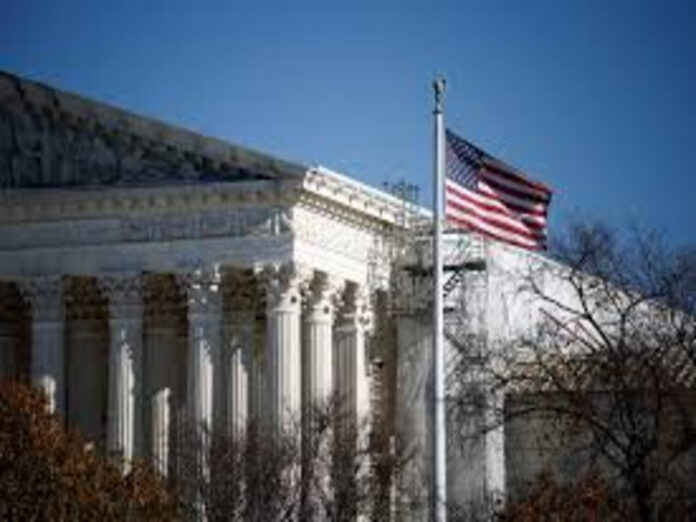
Justices Take Up Historic Challenge To Executive Directive At Center Of Immigration And Constitutional Showdown
Friday, December 5, 2025, 6:15 P.M. ET. 7 Minute Read, By Jennifer Hodges, Political Editor: Englebrook Independent News,
WASHINGTON, DC.- The U.S. Supreme Court on Friday agreed to hear a landmark challenge to President Donald Trump’s executive order seeking to revoke automatic U.S. citizenship for many children born on American soil to non-citizen parents, setting the stage for one of the most consequential constitutional battles over immigration in more than a century.

The Court granted expedited review in Trump v. Barbara, a nationwide class-action lawsuit brought on behalf of children who would be denied citizenship under Executive Order 14160, titled “Protecting the Meaning and Value of American Citizenship.” The move sends the case directly to the nation’s highest court, bypassing the federal appeals process due to the sweeping national importance of the issue.
This marks the first time in modern history that the Supreme Court will directly reconsider the scope of birthright citizenship under the 14th Amendment since its 1898 decision in United States v. Wong Kim Ark, which has long been understood to guarantee citizenship to nearly all children born on U.S. soil.
What Trump’s Executive Order Does;
President Trump signed Executive Order 14160 on January 20, 2025, his first day back in office. The order directs federal agencies to deny automatic U.S. citizenship to children born in the United States if:
- Neither parent is a U.S. citizen nor a lawful permanent resident, and
- The parents are present in the country illegally or only on temporary visas, such as tourist or student visas.
The administration argues that such children are not truly “subject to the jurisdiction” of the United States as described in the 14th Amendment and therefore fall outside the amendment’s original intent.

Supporters of the order, including more than two dozen Republican-led states, argue the policy is necessary to close what they call a long-standing loophole that encourages illegal immigration and organized birth tourism.
Civil-rights organizations, constitutional scholars, and multiple Democratic-led states argue that the president lacks the authority to redefine citizenship by executive order and that the policy directly contradicts more than 125 years of Supreme Court precedent.
How The Case Reached The Supreme Court;
Immediately after the order was signed, multiple legal challenges were filed across the country. Several federal judges issued nationwide injunctions blocking enforcement, ruling that the order likely violates both the U.S. Constitution and federal nationality law.
In June, the Supreme Court ruled in Trump v. CASA that lower courts generally may not issue universal nationwide injunctions that apply to non-parties. That decision shifted legal strategy toward class-action relief.
In July, U.S. District Judge Joseph Laplante in New Hampshire certified a nationwide class of children, including unborn children, who would be affected by the order and issued a new injunction blocking enforcement.
Rather than wait for months of appellate litigation, the Trump administration asked the Supreme Court to take the case immediately. The Court agreed, signaling the gravity of the constitutional question.
Oral arguments are expected in the spring of 2026, with a final ruling anticipated by late June, just months before the midterm elections.
The Constitutional Question;
At the heart of the case is one sentence of the 14th Amendment:
“All persons born or naturalized in the United States, and subject to the jurisdiction thereof, are citizens of the United States.”
In United States v. Wong Kim Ark (1898), the Supreme Court ruled that a man born in San Francisco to non-citizen Chinese parents was a U.S. citizen by birth. The decision established jus soli, citizenship by place of birth, as the governing standard, with only narrow exceptions for children of foreign diplomats, enemy occupiers, and certain tribal members.
For more than a century, that ruling has been understood to apply regardless of a child’s parents’ immigration status.
The Trump administration now argues that children of illegal immigrants and temporary visa holders are not fully “subject to the jurisdiction” of the United States because their parents maintain legal allegiance to another nation.
Opponents counter that the amendment’s framers explicitly rejected such limitations and that the administration’s argument undermines the very purpose of the 14th Amendment, which was adopted to ensure birthright citizenship after the Civil War.
How Birthright Citizenship Has Been Used, And Allegedly Abused;
Bush-Era “Anchor Children” Statistics;
During the George W. Bush administration, the unauthorized immigrant population surged to an estimated 11–12 million, peaking around 2007.
According to Pew Research data, in 2008:
- Roughly 340,000 babies, about 8 percent of all U.S. births, were born to at least one unauthorized immigrant parent.
- Approximately 4 million U.S.-born children were living in the country with at least one parent who was in the U.S. illegally.
These children were automatically granted full U.S. citizenship at birth, gaining access to all rights afforded to American citizens, including Social Security numbers, government benefits, and future voting rights.
Critics argue that this created a powerful incentive for illegal immigration and gave rise to the term “anchor children,” referring to the belief that citizenship for the child would eventually secure legal status for the parents.
However, federal law currently prohibits a U.S.-born child from sponsoring parents for legal residency until age 21, and even then, unlawful entry can permanently bar legal status, limiting the so-called anchoring effect.
Birth Tourism and Visa Abuse;
Another growing concern involves organized birth tourism, where foreign nationals enter the United States legally on visitor visas, sometimes through fraud or misrepresentation, specifically to give birth so their child receives U.S. citizenship.
Federal investigations have documented large birth tourism networks operating in states such as California, involving housing rings, medical brokers, and overseas recruitment agencies.
Though these cases represent a small percentage of total U.S. births, they have become a centerpiece of political arguments in favor of restricting birthright citizenship.
Today’s Numbers;
Recent studies estimate that roughly 6 percent of U.S. births today are to undocumented immigrant mothers, indicating that the issue remains significant despite shifting migration patterns.
Supporters of Trump’s executive order argue that ending automatic birthright citizenship would remove a major incentive for illegal entry and visa fraud. Opponents argue that labor demand, economic hardship, and violence in home countries, not birthright citizenship, remain the primary drivers of illegal immigration.
What’s at Stake;
If the Supreme Court upholds Trump’s order, it would mark the first time a president has successfully narrowed citizenship at birth without a constitutional amendment.
Potential consequences include:
- Tens of thousands of children per year could be born without U.S. citizenship, potentially becoming stateless.
- State and federal agencies would be forced to verify parental immigration status at birth, fundamentally changing how citizenship is documented.
- The ruling could reshape the interpretation of the 14th Amendment and invite new challenges to long-settled constitutional doctrines.
If the Court strikes down the order, it would reaffirm traditional birthright citizenship and limit presidential authority to redefine constitutional rights through executive action.
What Happens Next;
The Supreme Court will hear arguments in the spring of 2026. A decision is expected by late June.
Until then, the lower court’s injunction remains in effect, and children born in the United States continue to receive U.S. citizenship at birth, regardless of their parents’ immigration status.
Editor’s Note:
This article is based on publicly available records and reporting from the U.S. Supreme Court’s December 2025 order list, the full text of President Trump’s Executive Order 14160, and coverage from the Associated Press, Reuters, SCOTUSblog, and Democracy Docket. Historical constitutional analysis is drawn from the Library of Congress, the National Constitution Center, and legal summaries of United States v. Wong Kim Ark.. Statistical data regarding immigrant births and “anchor children” during the George W. Bush administration. Subsequent years are based on research from the Pew Research Center, the Migration Policy Institute, the Centers for Disease Control and Prevention, and the U.S. Department of Homeland Security.
— Jennifer Hodges, Political Editor, Englebrook Independent News