White House Frames Opioid Crisis As National-Security Threat, Directing DOJ, State, Treasury, DHS, And Pentagon-Linked Resources To Escalate Enforcement
Tuesday, December 16, 2025, 12:15 P.M. ET. 4 Minute Read, By Jennifer Hodges, Political Editor: Englebrook Independent News,
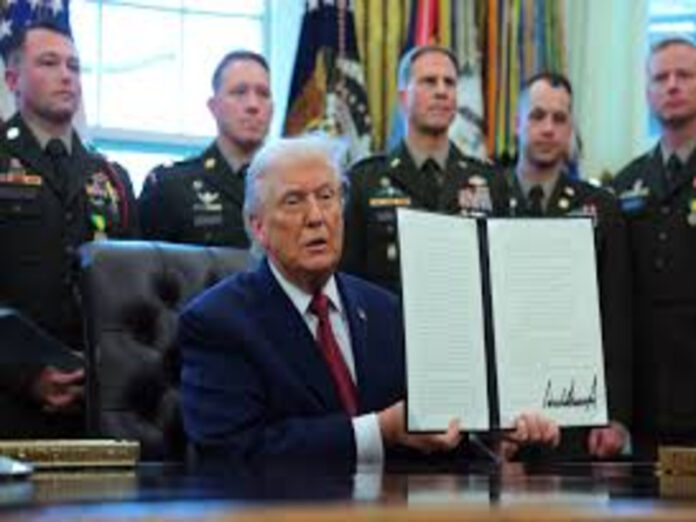
WASHINGTON, DC.- President Donald Trump signed a sweeping executive order Monday from the Oval Office formally designating illicit fentanyl, and its core precursor chemicals, as “Weapons of Mass Destruction” (WMD), a label typically reserved for chemical, biological, radiological, or nuclear threats.

In the order’s opening section, the White House argues that fentanyl is “closer to a chemical weapon than a narcotic,” citing its extreme potency and warning that adversaries could weaponize it for large-scale attacks. The executive order states that two milligrams, “equivalent to 10 to 15 grains of table salt,” can be a lethal dose.
What The Executive Order Does;
The order’s operational core is a government-wide directive to treat fentanyl trafficking not only as a criminal enterprise but as a national-security threat, triggering broader tools and coordination.
Key directives include:
- Justice Department escalation: The Attorney General is instructed to “immediately pursue” fentanyl trafficking investigations and prosecutions, including criminal charges, sentencing enhancements, and sentencing variances where appropriate.
- Financial and diplomatic pressure: The Secretaries of State and Treasury are directed to pursue actions “against relevant assets and financial institutions” tied to fentanyl manufacturing, distribution, or sale, consistent with applicable law.
- Defense resources for domestic enforcement: The order directs the Secretary of War and the Attorney General to assess whether fentanyl-related threats warrant the provision of Department of War resources to support DOJ enforcement under Title 18, referencing 10 U.S.C. § 282.
- Chemical-incident posture update: The Secretary of War, in consultation with DHS, is directed to update directives governing Armed Forces responses to chemical incidents in the homeland to include fentanyl.
- Intelligence-driven network targeting: DHS is directed to identify fentanyl threat networks using WMD- and nonproliferation-related intelligence to support “the full spectrum” of counter-fentanyl operations.
Definitions: What The White House Means By “Illicit Fentanyl” And “Core Precursors;”
The executive order defines “illicit fentanyl” as fentanyl manufactured, distributed, dispensed, or possessed with intent to distribute in violation of the Controlled Substances Act, citing 21 U.S.C. §§ 841 and 846.
It defines “core precursor chemicals” as the chemicals used to create illicit fentanyl and analogues, naming piperidone and other piperidone-based substances as examples.
Why The Administration Is Making The Move Now;
In a parallel White House fact sheet, the administration frames the designation as a necessary escalation to “mobilize” the federal government against what it calls a deadly chemical threat, linking fentanyl profits to organized criminal networks and foreign terror-linked actors.
The designation is widely viewed as unprecedented for a narcotic and could enable broader involvement from defense and intelligence agencies using tools typically associated with countering WMD proliferation, raising legal and policy questions about the reach of existing federal authorities.
The Fentanyl Toll: Where The Numbers Stand;
The executive order arrives amid a still-devastating overdose crisis, even as national data show signs of improvement.
- CDC provisional data estimate 80,391 drug overdose deaths in 2024, down 26.9 percent from 110,037 in 2023.
- Overdose deaths involving opioids declined from 83,140 in 2023 to 54,743 in 2024 (deaths can involve multiple substances).
- Fentanyl alone was linked to 72,776 overdose deaths in 2023, underscoring its dominant role in the synthetic-opioid epidemic.
The White House continues to cite fentanyl as a leading cause of death among Americans ages 18 to 45, a central justification for elevating the crisis to a national-security level.
What Happens Next;
In practical terms, the executive order signals a more aggressive, security-driven approach to fentanyl, combining traditional criminal prosecution with sanctions, intelligence targeting, and potential Department of War support.
Whether the WMD designation produces measurable results, disrupting supply chains, deterring precursor shipments, or reducing overdose deaths, will depend on how quickly agencies operationalize the directive, how courts interpret expanded enforcement theories, and whether international partners cooperate in shutting down precursor pipelines and transnational trafficking networks.
Editor’s Note:
This report is based on the White House executive order “Designating Fentanyl as a Weapon of Mass Destruction” (December 15, 2025), the accompanying White House fact sheet, and overdose mortality statistics published by the U.S. Centers for Disease Control and Prevention (CDC). Additional context was drawn from contemporaneous wire reporting and public federal data. Jennifer Hodges, Political Editor, Englebrook Independent News.