President’s New Policy Takes Effect February 1, 2026; Legal Battles Loom As Multiple States Prepare Lawsuits
Thursday, January 15, 2026, 7:15 A.M. ET. 4 Minute Read, By Haylee Ficuciello, Economy & Finance Editor: Englebrook Independent News,
WASHINGTON, DC.- President Donald Trump announced Tuesday that, beginning February 1, 2026, the federal government will withhold all federal funding from so-called “sanctuary cities” and the states that house them, escalating a long-running national conflict over immigration policy and federal-state relations.

Speaking at the Detroit Economic Club on January 13, President Trump said his administration will cease making federal payments to jurisdictions that maintain sanctuary policies, defined broadly as local or state laws limiting cooperation with federal immigration enforcement agencies such as Immigration and Customs Enforcement (ICE). The administration claims the policy is necessary to address what it calls increased crime and fraud in these jurisdictions, though specific categories of funding affected have not yet been fully detailed by the White House.
“Effective February 1st, no more payments will be made by the federal government to states for their corrupt criminal protection centers known as sanctuary cities,” the president stated, asserting that these jurisdictions “breed crime and violence” and should “pay for them” if they choose to adopt such policies.
Federal Funding At Stake;
The policy’s reach is potentially enormous.
Federal aid constitutes a major portion of many state and local budgets, funding everything from infrastructure and education grants to public safety and health-care services. In major sanctuary states such as California, federal funding totals in the hundreds of billions of dollars annually when including transportation, Medicaid, disaster relief, law-enforcement grants, housing programs, and environmental funding.
State and city officials in targeted jurisdictions warn that the financial impact could be severe. California Attorney General Rob Bonta publicly stated that legal action would follow if federal funds are cut, arguing that courts have repeatedly ruled against similar efforts and that states have constitutional protections from federal coercion.
Local governments, particularly in California, New York, Illinois, Massachusetts, and Washington, are coordinating legal responses and preparing emergency budget contingencies should funding interruptions occur.
Litigation Expected Nationwide;
Legal experts expect an immediate wave of lawsuits challenging the Trump administration’s directive.
Previous attempts by the federal government to use funding as leverage against sanctuary jurisdictions have been blocked by federal courts, including injunctions issued during earlier Trump administration efforts and later reaffirmed in 2025. Courts have consistently ruled that the executive branch cannot impose new funding conditions that were not explicitly authorized by Congress.
Multiple governors and state attorneys general have already signaled they will file suit, arguing the policy violates the U.S. Constitution’s Spending Clause, the separation of powers, and long-standing federal grant law.
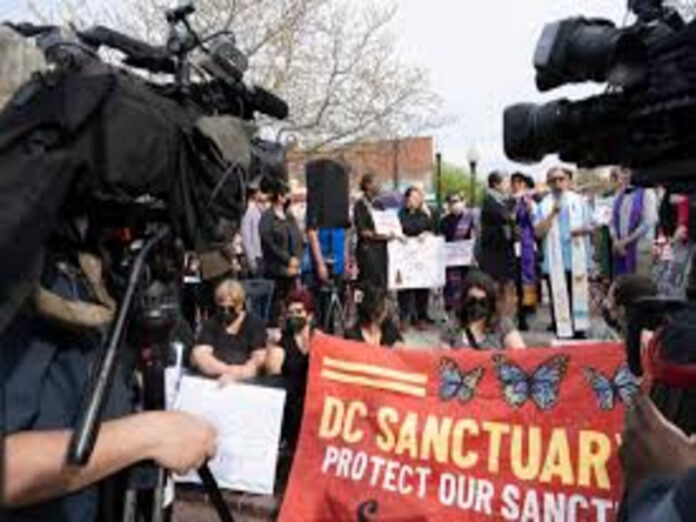
Major cities such as Los Angeles, San Francisco, Chicago, and New York City have also reaffirmed their sanctuary policies and pledged to challenge any attempt to withhold federal funds.
Political And Economic Implications;
The announcement immediately escalates a national confrontation between the Trump administration and Democrat-led states and cities over immigration enforcement and public safety.
Supporters of sanctuary policies argue they encourage immigrant communities to cooperate with local police without fear of deportation. Opponents, including the Trump administration, argue the policies obstruct federal immigration law and create public-safety risks.
From an economic standpoint, sudden funding withdrawals could disrupt infrastructure projects, health-care systems, emergency services, law enforcement programs, and education funding for millions of Americans living in sanctuary jurisdictions. Analysts warn that prolonged legal uncertainty could also impact municipal bond markets and state credit ratings.
What Happens Next;
With the February 1 deadline approaching rapidly, legal filings are expected within days. States are expected to seek emergency injunctions to block the funding cuts while courts determine whether the federal government has the authority to carry them out.
The White House maintains it has broad discretion to enforce immigration priorities through federal spending decisions, though it has not yet released the full legal framework supporting the move.
What is certain is that the country is headed toward another high-stakes constitutional showdown, one that could reshape the relationship between Washington and the states on immigration, law enforcement, and federal funding.
Editor’s Note:
This article is based on verified reporting from multiple national news organizations covering President Trump’s announcement and the legal and political responses from state and local governments. Englebrook Independent News will continue monitoring court filings, budgetary impacts, and federal actions as the February 1, 2026, deadline approaches. Verified by Haylee Ficuciello and the editorial staff of Englebrook Independent News.