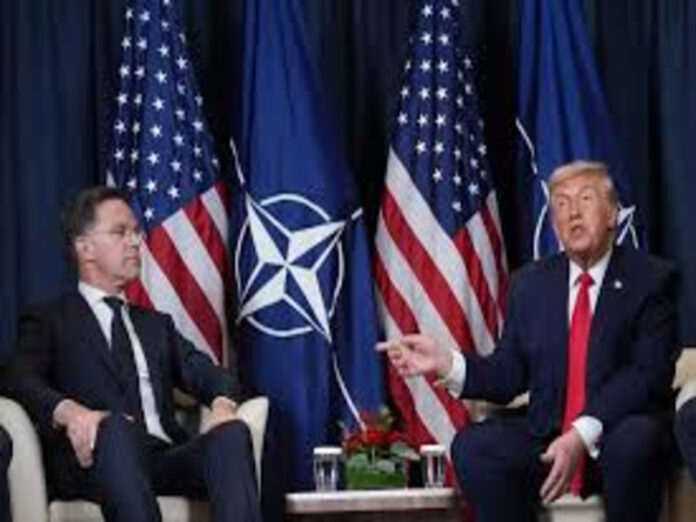
Markets Surge As President Trump Signals Strategic De-Escalation With Europe; NATO Chief Emphasizes Arctic Security Focus
Thursday, January 22, 2026, 7:00 A.M. ET. 5 Minute Read, By Haylee Ficuciello, Economy & Finance Editor: Englebrook Independent News,
MANHATTAN, NY.- U.S. stocks surged Wednesday after President Donald Trump announced he would pause planned tariffs against several European Union countries, a move that markets welcomed as a calculated act of economic leadership following high-level meetings at the World Economic Forum in Davos.

The decision came after what the White House described as a “very productive” meeting with NATO Secretary General Mark Rutte, during which the two discussed a developing “framework of a future deal” involving Greenland and broader Arctic security cooperation. Investors viewed the announcement as a clear signal that the administration is prioritizing stability, strategic negotiation, and long-term U.S. economic interests.
By the closing bell on Wednesday, January 21, 2026, Wall Street responded decisively. The Dow Jones Industrial Average rose 588.64 points, or 1.21%, to 49,077.23. The S&P 500 gained 78.76 points, or 1.16%, to 6,875.62, while the Nasdaq Composite advanced 270.50 points, or 1.18%, to 23,224.83.
The rally marked a sharp reversal from Tuesday’s pullback, which had been driven largely by uncertainty surrounding potential tariff escalation. Wednesday’s gains reflected renewed investor confidence that the administration is using trade policy as leverage, while remaining willing to de-escalate when constructive diplomatic progress is achieved.
Strategic Pause On Tariffs After Davos Discussions;
President Trump confirmed that tariffs previously scheduled to take effect on February 1 would not move forward, citing tangible progress made during discussions with NATO leadership.
“We have the framework of a future deal with respect to Greenland and, in fact, the entire Arctic Region,” Trump said following the meeting. “Based upon this understanding, I will not be imposing the tariffs that were scheduled to go into effect.”
The tariffs had been aimed at exports from eight European countries and had contributed to heightened market volatility earlier in the week. Their suspension was widely interpreted as a strategic move designed to preserve U.S. negotiating leverage while avoiding unnecessary economic friction with allied nations.
Trump described the emerging framework as a long-term strategic arrangement focused on Arctic defense, geopolitical stability, and access to critical resources, including minerals essential to advanced manufacturing and national security.
Calling it “the ultimate long-term deal,” Trump emphasized that the discussions were rooted in cooperation rather than confrontation. During his Davos appearance, he addressed speculation about military action directly, stating, “I don’t want to use force. I won’t use force.”
NATO Secretary General Highlights Security Cooperation;
NATO Secretary General Mark Rutte offered additional context on the talks, underscoring that the discussions centered on regional security rather than political sovereignty.
When asked whether Greenland’s status or governance was addressed, Rutte responded, “That issue did not come up anymore in my conversations tonight with the president.”
Rutte said President Trump was focused on strengthening protections across the Arctic region, particularly amid increased activity by Russia and China.
“He is very much focused on what we need to do to make sure that that huge Arctic region, how we can protect it,” Rutte said.
The comments reinforced the administration’s stated position that its Greenland interest is rooted in defense, strategic positioning, and allied security, not territorial expansion.
Markets Respond To Leadership And Clarity;
For investors, the takeaway was immediate: the White House demonstrated a willingness to recalibrate trade actions when progress is made, reducing the risk of retaliatory tariffs and global disruption.
“What is the economic impact is whether we all start imposing tariffs on each other,” said Jason Pride, chief investment strategist at Glenmede, reflecting broader market sentiment earlier in the week.
Wednesday’s rally was broad-based. All eleven S&P 500 sectors advanced, led by energy stocks, with additional strength in financials following strong bank earnings. Cyclical sectors, including airlines and industrials, also rebounded as confidence returned.
Analysts noted that Tuesday’s decline, described as the sharpest single-day pullback in months, was driven by policy uncertainty rather than economic fundamentals. Trump’s announcement helped resolve that uncertainty swiftly.
Greenland, Trade Policy, And The Path Forward;
President Trump’s renewed focus on Greenland and the Arctic reflects a broader strategy emphasizing U.S. security, critical mineral access, and geopolitical readiness in a region of growing global competition.
The United States already maintains a strategic presence in Greenland, and the administration has consistently linked Arctic policy to missile defense, supply-chain resilience, and national security priorities.
While details of the proposed framework remain forthcoming, Wednesday’s market response highlighted investor approval of the administration’s approach: assertive in negotiation, pragmatic in execution, and responsive to economic consequences.
As trade policy continues to serve as a central tool of U.S. diplomacy, markets are likely to remain attentive to future developments. For now, investors appear reassured that the White House is balancing strength with restraint, an approach that markets rewarded decisively.
Editor’s Note:
This article was written by Haylee Ficuciello, Economy & Finance Editor for Englebrook Independent News, using verified market data and publicly reported statements from President Donald Trump and NATO Secretary General Mark Rutte. All quotations, index closes, dates, and contextual details were cross-checked against contemporaneous wire-service and mainstream financial reporting published January 21–22, 2026.