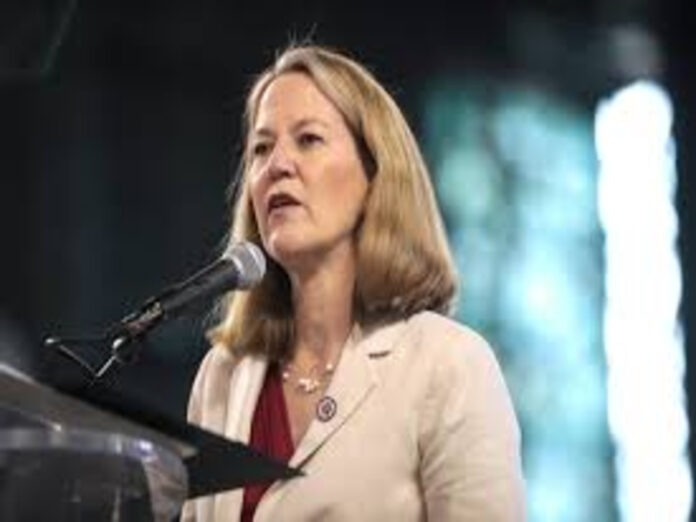
Critics Say The Attorney General’s Remarks Could Be Interpreted As Permission For Violence Against Federal Agents & Endanger Local Officers Responding To Chaotic Scenes
Saturday, January 24, 2026, 10:15 A.M. ET. 5 Minute Read, By Jennifer Hodges, Political Editor: Englebrook Independent News,
PHOENIX, AZ.- Arizona Attorney General Kris Mayes is facing intensifying calls to resign after remarks she made this week tying Arizona’s self-defense and “Stand Your Ground” laws to the risk of confrontations during federal immigration enforcement operations, particularly when agents are masked or not clearly identifiable.

Mayes’ comments, delivered during media interviews and a radio segment, were framed by her office as a warning about “combustible” scenarios that could arise if residents believe they are confronting armed intruders rather than law enforcement. But Republican officials and police representatives argue that the attorney general’s public explanation of when lethal force may be lawful effectively serves as a “tutorial” that could embolden civilians to take violent action against ICE agents, and create dangerous conditions for any local or state officers who respond to the scene.
What Mayes Said;
In an interview highlighted this week, Mayes described the collision between masked, plainclothes federal enforcement tactics and Arizona’s expansive self-defense provisions as “a recipe for disaster,” citing the state’s laws that can allow lethal force when a person reasonably believes their life is in danger.
“It’s kind of a recipe for disaster because you have these masked federal officers with very little identification … wearing plain clothes and masks,” Mayes told a Phoenix television reporter. She continued: “And we have a Stand Your Ground law that says that if you reasonably believe that your life is in danger and you’re in your house or your car or on your property, that you can defend yourself with lethal force.”
In a separate exchange reported by Arizona’s Family, Mayes discussed lawful self-defense in terms of lethal force, agreeing with a host’s hypothetical about defending oneself from an armed person approaching a car, an exchange that critics say, taken together with the ICE context, risked being read as validation for shooting officers.
Mayes also stated she was not advocating violence against law enforcement, emphasizing the importance of identification.
“I don’t want people using lethal force ever, ever against a police officer but police officers, cops, identify themselves,” she said.
Why The Remarks Sparked Backlash;
Police and Republican leaders argue the practical effect of Mayes’ statements is to increase the likelihood of armed confrontations, especially during high-stress raids where residents may already be anxious, and confusion can spread rapidly.
Joe Clure, executive director of the Arizona Police Association, said he viewed the attorney general’s remarks as “basically giving a tutorial on how to shoot police officers, specifically ICE agents.”
Arizona Senate Majority Leader John Kavanagh called for Mayes to retract the comments and resign.
“The AG has to first immediately retract what she said, admit that it was bad and dangerous advice, and following that, she needs to resign in disgrace,” Kavanagh said.
Other Republican officials echoed concerns that even if Mayes intended to warn about potential outcomes, her words could be weaponized, online or in real-world encounters, as justification to use violence against law enforcement officers.
The Legal Backdrop: Arizona’s Use-Of-Force Statutes;
Arizona law allows the use of physical force in self-defense when a reasonable person would believe force is immediately necessary to protect against another’s unlawful force.
State statutes also define circumstances under which deadly force may be justified, including when a reasonable person believes it is immediately necessary to protect against another’s use or attempted use of unlawful deadly physical force.
Arizona’s “Stand Your Ground” framework also includes limitations and exceptions, particularly involving law enforcement officers performing official duties, an important legal distinction critics argue is often lost when public officials speak broadly about lethal self-defense.
The Operational Danger: Split-Second Decisions And Secondary Scenes;
Law enforcement professionals consistently warn that the most dangerous moments often come after the initial encounter, when neighbors call 911, multiple agencies respond, and armed civilians attempt to intervene without understanding who is present or what authority they carry.
Critics argue that public messaging emphasizing lethal-force scenarios, especially when paired with discussion of masked federal officers, raises the risk of vigilantism, misidentification, and tragic outcomes. Local and state officers responding to “shots fired” calls could be injured or killed while attempting to restore order.
Mayes defended her remarks as a factual description of Arizona law.
“I’m shocked that there are Republicans down at the legislature that are criticizing me for saying what is a fact in Arizona,” she said. “It’s the law… It is the law. It’s a law they passed by the way.”
Her office has also pointed to concerns that rapidly expanded enforcement operations could increase volatility, particularly if agents are not clearly identifiable or lack experience.
Where The Controversy Goes Next;
With the dispute now drawing national attention, and with police associations and legislative leaders escalating calls for a retraction and resignation, focus is shifting to whether Mayes will issue a formal clarification and whether federal agencies will adjust operational practices in Arizona to mitigate misidentification risks.
At the center of the controversy is a reality acknowledged by all sides: when enforcement actions intersect with fear and confusion, the margin for error narrows, and the consequences can be irreversible.
Editor’s Note:
This report was written by Jennifer Hodges, Political Editor for Englebrook Independent News, and is based on contemporaneous coverage of Attorney General Kris Mayes’ public remarks and responses from Arizona law enforcement organizations and elected officials. Quotations attributed to Mayes and her critics are drawn from published reporting by Axios Phoenix and Arizona’s Family (3TV/CBS5). Englebrook Independent News verified all statements for accuracy and context prior to publication.