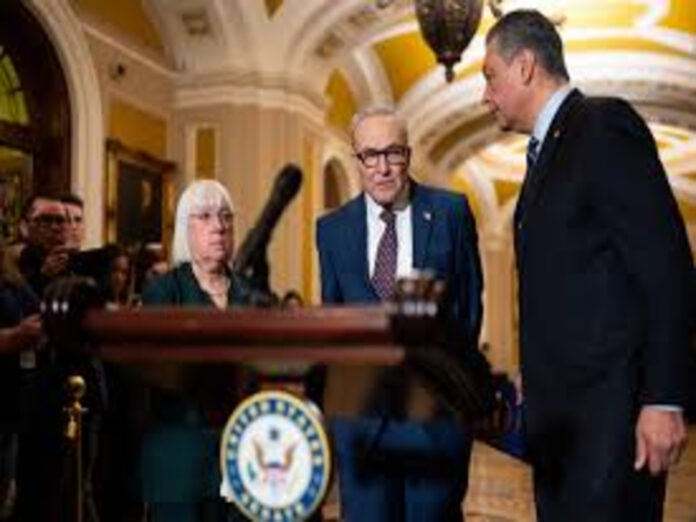
While Core Border Enforcement Remains Funded Through 2029, DHS Administrative and Oversight Functions Face Possible Disruption
Friday, January 30, 2026, 9:00 A.M. ET. 5 Minute Read, By Haylee Ficuciello, Economy & Finance Editor: Englebrook Independent News,
WASHINGTON, DC.- Senate Democrats and the White House reached a last-minute agreement Thursday night aimed at averting a partial shutdown of the federal government over funding for the Department of Homeland Security (DHS). However, with the U.S. House of Representatives not scheduled to return to Washington until Monday, the short-term funding plan may not be approved in time, raising the prospect of a brief partial shutdown despite bipartisan agreement in the Senate.

The dispute centers on discretionary DHS funding set to expire at midnight Friday. While the department oversees multiple federal agencies, including Immigration and Customs Enforcement (ICE), Customs and Border Protection (CBP), the Transportation Security Administration (TSA), and the U.S. Coast Guard, the funding lapse under debate would not halt all DHS operations equally.
What Is, And Is Not, At Risk;
Importantly, core funding for ICE and CBP is already secured through fiscal year 2029 under sweeping immigration and border security legislation signed into law on July 4, 2025. That law provided multi-year mandatory appropriations for frontline border enforcement, detention operations, personnel salaries, and deportation activities.
As a result, ICE and CBP operations would continue uninterrupted even in the event of a partial DHS shutdown, as mandatory appropriations do not lapse when discretionary funding expires.
What remains at risk instead are DHS administrative, oversight, and discretionary components, including headquarters operations, civil rights and compliance offices, inspector general activity, policy initiatives, and certain support functions not covered by long-term statutory funding.
Details Of The Senate-White House Agreement;
Under the compromise reached Thursday, the majority of federal agencies would receive full funding through the remainder of the fiscal year ending September 30, 2026. DHS, however, would be funded through a two-week continuing resolution, maintaining current discretionary spending levels while negotiations continue over immigration-related oversight and enforcement policy.
The agreement separates DHS from a broader six-bill appropriations package that includes funding for the Departments of Defense, Labor, Health and Human Services, Education, and State. Senate Democrats blocked an earlier procedural vote, insisting that DHS funding be carved out to allow continued debate over policy conditions tied to enforcement oversight.
President Donald Trump publicly endorsed the compromise, stating that Republicans and Democrats had “come together to get the vast majority of the Government funded until September,” while allowing additional time to resolve remaining DHS issues.
Immigration Enforcement As A Political Pressure Point;
Although ICE and CBP funding are statutorily protected, DHS has remained a focal point of political pressure amid Democratic demands for expanded oversight of immigration enforcement practices. Senate Democrats have pushed for increased reporting requirements, operational restrictions, and internal review mechanisms tied to DHS leadership and administrative offices, not frontline enforcement.
By leveraging DHS discretionary funding, Democrats have sought policy concessions while avoiding direct defunding of border enforcement agencies, whose funding was settled legislatively last year.
Republican Response And Senate Dynamics;
Republican senators largely viewed the temporary DHS extension as the only viable option to prevent a funding lapse. However, some raised concerns that repeated short-term resolutions prolong uncertainty and invite recurring shutdown threats despite previously enacted long-term funding for enforcement agencies.
Earlier Thursday, the Senate failed to advance the broader appropriations package after falling short of the 60 votes required to overcome a filibuster, prompting renewed negotiations that led to the late-night compromise.
House Schedule Creates Risk Of Funding Lapse;
While the Senate is expected to approve the split-funding plan, the House of Representatives remains the key obstacle. The Republican-controlled House passed its own appropriations bill earlier this month, including full-year DHS funding, but it is not scheduled to reconvene until Monday.
Because the House will not be in session before the current discretionary DHS funding expires, a partial shutdown affecting non-mandatory DHS functions could occur over the weekend even if Senate action proceeds as planned.
House leadership has acknowledged the risk, noting procedural timelines may make a brief funding lapse unavoidable. Some conservative members have also criticized the Senate deal, arguing it opens the door to future concessions on immigration oversight.
Economic And Operational Implications;
While a partial DHS shutdown would not halt border enforcement or deportation operations, it could disrupt administrative services, delay internal reviews, and suspend discretionary initiatives across the department. Previous shutdowns have also delayed regulatory actions, internal audits, and federal reporting functions relied upon by businesses and policymakers.
Economists note that even limited shutdowns increase uncertainty, particularly when political messaging obscures which government functions are actually affected.
With funding deadlines looming and House action delayed, lawmakers face mounting pressure to finalize appropriations, even as core immigration enforcement remains fully funded by law.
Editor’s Note:
Core funding for Immigration and Customs Enforcement and Customs and Border Protection was enacted through fiscal year 2029 under federal law signed July 4, 2025, and is not subject to lapse under the current DHS funding dispute. This article was written by Haylee Ficuciello, Economy & Finance Editor, and reflects verified information available as of publication time. Englebrook Independent News will continue to monitor and update this story as developments unfold.