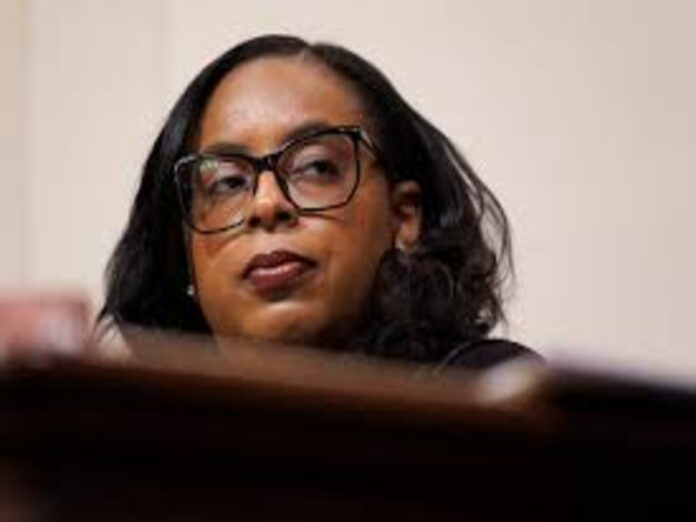
New Jersey Congresswoman, Facing Federal Charges Tied To An ICE Facility Incident, Drew Backlash After Asking Acting ICE Director Todd Lyons If He’s “Going To Hell” During A Hearing Meant To Scrutinize DHS Operations
Wednesday, February 11, 2026, 8:30 A.M. ET. 5 Minute Read, By Jennifer Hodges, Political Editor: Englebrook Independent News,
WASHINGTON, DC.- A U.S. House Homeland Security oversight hearing intended to examine the operations and accountability of America’s immigration agencies veered into political spectacle Tuesday, after Rep. LaMonica McIver (D–N.J.) launched into a deeply personal exchange with Acting ICE Director Todd Lyons, culminating in the question: “Do you think you’re going to hell, Mr. Lyons?”

The hearing, formally titled “Oversight of the Department of Homeland Security: ICE, CBP, and USCIS,” featured testimony from Todd Lyons of Immigration and Customs Enforcement, Rodney Scott of U.S. Customs and Border Protection, and Joseph Edlow of U.S. Citizenship and Immigration Services. It was scheduled amid heightened scrutiny of immigration enforcement following recent high-profile incidents and renewed debate over the scope, conduct, and transparency of federal operations.
But the moment that ricocheted across political media was not a data-driven exchange about detention capacity, deportation priorities, border processing, or internal discipline. It was McIver, a member of Congress currently fighting a federal prosecution connected to a prior oversight visit at an ICE-linked facility in Newark, New Jersey, shifting the hearing into an afterlife referendum on Lyons’ moral standing.
“Judgment Day,” “Blood On Your Hands,” And A Hearing That Lost The Plot;
According to multiple published accounts and circulating footage from the hearing, McIver pressed Lyons on whether he considered himself religious, then asked how “Judgment Day” would “work” for him “with so much blood on your hands,” before escalating to the direct question about hell. Lyons declined to engage, telling her he would not entertain the line of questioning and would not answer the “hell” question.
Republicans on the committee sought to steer the discussion back to public safety, policy implementation, and agency oversight. Committee Chairman Andrew R. Garbarino (R–N.Y.) has positioned the hearing series as part of a broader push to evaluate public trust and operational standards inside DHS components.
Yet Democrats repeatedly returned to emotionally charged rhetoric during the session, with the hearing also featuring sharp comparisons and disputes about enforcement tactics and recent controversies surrounding immigration operations.
To critics, McIver’s approach looked less like oversight than a made-for-clips confrontation, a “linebacker-style blitz” of moral condemnation that did little to clarify policy, improve agency performance, or extract verifiable commitments on procedure and accountability. The exchange produced heat, not light: no new operational details, no confirmed corrective actions, and no measurable oversight outcomes tied to her most viral questions.
The Newark Backdrop: McIver’s Pending Federal Case;
McIver’s theatrics on Tuesday did not occur in a vacuum. She is currently defending against a three-count federal indictment stemming from a May 9, 2025, incident outside the Delaney Hall Federal Immigration Facility in Newark, where prosecutors allege she forcibly impeded and interfered with federal officers during the attempted arrest of Newark Mayor Ras Baraka.
The U.S. Attorney’s Office in New Jersey has alleged that McIver surrounded the mayor and interfered with officers’ efforts to handcuff him, including allegations that she struck officers with her forearms and attempted to restrain an officer by grabbing him. The Department of Justice states that if convicted, she faces maximum penalties of eight years on Count One, eight years on Count Two, and one year on Count Three, a combined exposure often summarized publicly as up to 17 years.
A federal judge previously rejected key arguments seeking to dismiss her case, ruling that alleged actions that interfered with an arrest went beyond the safe harbor of legislative immunity as framed in her motion.
McIver has pleaded not guilty, and like all defendants, she is presumed innocent unless proven guilty beyond a reasonable doubt.
Oversight Or Performance Art;
Democrats frequently argue that their most confrontational moments are necessary to spotlight perceived abuses and force accountability. But oversight is supposed to be more than moral signaling. It is meant to extract facts, secure documentation, compel commitments, and produce reforms that can be tracked, verified, and audited.
McIver’s questioning on Tuesday did not meaningfully advance that mission.
Instead, it reinforced a growing perception among voters: that a segment of the Democratic caucus is more interested in viral confrontation than practical governance, more focused on personal condemnation than measurable oversight. Even on issues where legitimate scrutiny exists, theatrics can degrade the credibility of Congress’s supervisory role and erode public confidence that hearings are anything more than partisan staging.
And for McIver specifically, the optics are unavoidable: a lawmaker facing federal allegations connected to a prior ICE-facility incident using a DHS oversight hearing to issue spiritual indictments, while the policy questions Americans expect Congress to answer remain clouded by political noise.
If Democrats want to argue they are the party of competence and reality-based governance, moments like Tuesday’s make that case harder, not because the topic is unimportant, but because the method looked unserious.
Editor’s Note:
This report was written by Jennifder Hodges, Political Editor, and is based on the House Homeland Security Committee’s published hearing information and same-day reporting describing and/or showing Rep. LaMonica McIver’s exchange with Acting ICE Director Todd Lyons, including her “Judgment Day” and “going to hell” questions. McIver’s federal case background and potential penalties are drawn from the U.S. Department of Justice press release issued June 10, 2025, and subsequent court reporting; an indictment is an allegation, and McIver is presumed innocent unless proven guilty in court.