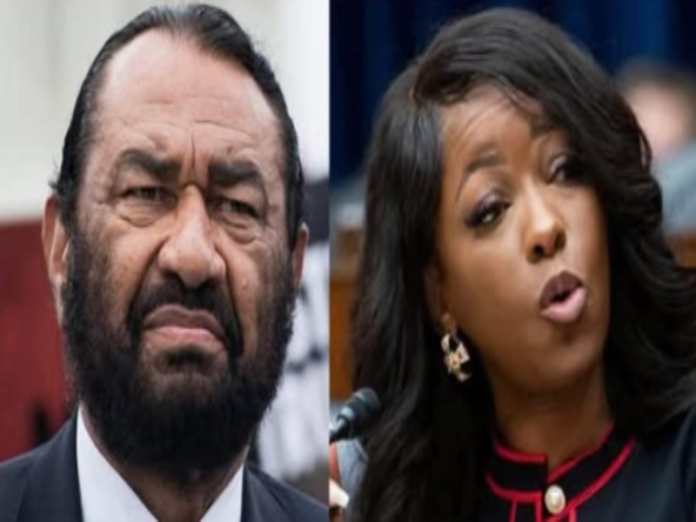
Democratic Voters Rebuke Two Of The Party’s Most Polarizing Figures In Texas Primaries Amid Questions Over Campaign Strategy, Spending, & Political Theatrics
Wednesday, March 4, 2026, 5:35 P.M. ET. 7 Minute Read, By Jennifer Hodges, Political Editor: Englebrook Independent News,
AUSTIN, TX.- Texas Democratic voters delivered a sharp political rebuke Tuesday night to two of the party’s most controversial figures, rejecting U.S. Representative Jasmine Crockett in the Democratic primary for U.S. Senate while forcing longtime Congressman Al Green into an unexpected runoff election after he failed to secure a majority in his own primary contest.
The results stunned many political observers and immediately intensified debate inside the Texas Democratic Party about its political direction, candidate selection, and messaging strategy heading into the 2026 midterm elections.

For Crockett, the defeat represents the abrupt collapse of a high-profile statewide campaign built largely on national media attention and viral political confrontations. For Green, the runoff marks one of the most serious political threats to his congressional career since first being elected to the House of Representatives more than two decades ago.
Crockett’s Senate Campaign Falters;
Crockett, who represents Texas’s 30th Congressional District, entered the Senate primary with significant national recognition after gaining attention for combative exchanges during congressional hearings and frequent appearances on cable news programs.
Her campaign attempted to translate that visibility into a statewide coalition capable of competing in Texas, a state where Democrats have struggled to win major statewide offices for decades.
Instead, Democratic voters chose Texas State Representative James Talarico, an Austin-area lawmaker who ran a campaign centered on economic issues, coalition-building, and reducing political polarization.
By Tuesday night, early returns indicated that Talarico had secured a decisive share of the Democratic vote.
Political analysts said the results reflected a fundamental disconnect between Crockett’s national political brand and the priorities of Texas primary voters.
“Social-media visibility and viral congressional moments don’t necessarily translate into a winning statewide coalition,” said one Texas political analyst following the results.
Crockett Blames Republicans for Primary Defeat;
Following her loss, Crockett issued statements suggesting that Republican attacks and conservative media coverage contributed to the outcome of the Democratic primary.
“Republicans targeted this campaign because they were afraid of a strong Democratic challenger,” Crockett said in remarks following the election.
But critics quickly pointed out that the race was a Democratic primary decided by Democratic voters, not a general election contest against Republican opponents.
Several Democratic strategists privately expressed frustration that Crockett appeared to blame outside forces rather than acknowledge internal weaknesses in her campaign strategy.
“Ultimately, this was a decision made by Democratic voters,” one strategist told reporters. “If the message didn’t resonate with Democratic primary voters, blaming Republicans doesn’t explain that.”
A Campaign Shadowed By Political Theater;
Crockett’s rapid rise in national Democratic politics has largely been fueled by high-profile clashes with Republican lawmakers during congressional hearings.
Those moments frequently went viral online and earned her praise among progressive activists.
But critics within the Democratic Party argued that the confrontational approach created a political persona built more on spectacle than on policy.
Several clips from congressional hearings, including exchanges that drew millions of views on social media, were later used by conservative groups in digital advertising campaigns aimed at portraying Crockett as emblematic of Washington’s increasingly combative political culture.
Moderate Democrats in Texas warned privately during the campaign that the strategy risked alienating voters in suburban and rural areas.
By the final weeks of the race, polling suggested Crockett struggled to expand support beyond major Democratic strongholds in Dallas, Houston, and Austin.
Investigative Review: Campaign Spending and Strategic Missteps;
A review of campaign filings and political spending data also raised questions about the structure of Crockett’s campaign.
Federal Election Commission filings show Crockett’s campaign spent heavily on consulting services, national media strategy, and digital advertising, areas critics say may have prioritized national exposure over grassroots organizing across Texas’ vast geographic landscape.
Political operatives familiar with Texas statewide campaigns noted that successful candidates often spend years building extensive networks of local organizers, county chairs, and regional campaign infrastructure.
Crockett’s campaign, by contrast, was widely viewed as relying on a smaller central operation supported by national progressive donors.
Several Texas Democratic officials privately warned during the race that the campaign appeared focused more on national visibility than on the ground-level organizing necessary to compete statewide.
“There’s a difference between winning attention and winning elections,” one longtime Texas Democratic consultant said after the results were announced.
Al Green Forced Into Rare Runoff;
While Crockett’s Senate campaign collapsed statewide, Congressman Al Green faced an unexpected challenge closer to home.

Green failed to secure more than 50 percent of the vote in the Democratic primary for Texas’s 9th Congressional District, forcing a runoff election against Harris County Attorney Christian Menefee.
Under Texas election law, candidates must receive a majority of the vote to win a primary outright. The runoff election is scheduled for May 26, 2026.
The district is heavily Democratic, meaning the winner of the runoff will likely secure the seat in the November general election.
Green’s Long Career Marked by Impeachment Campaigns;
Green, who has served in Congress since 2005, has long been known nationally for his repeated attempts to force impeachment proceedings against President Donald Trump.
Beginning during Trump’s first presidency and continuing in subsequent years, Green introduced multiple resolutions seeking impeachment or censure, sometimes acting independently of Democratic leadership.
In several cases, those efforts forced politically awkward votes on the House floor that Democratic leadership had attempted to avoid.
Green argued the actions were necessary to defend constitutional principles.
However, critics inside and outside the Democratic Party said the repeated impeachment efforts sometimes appeared more symbolic than strategic.
Some political observers also argued that the repeated motions contributed to growing partisan polarization in Congress.
During the current campaign cycle, Green once again raised impeachment as a political issue, a move that opponents argued reinforced the perception that the congressman was focused on national political battles rather than local district priorities.
Ethics Scrutiny and Generational Challenge;
Green’s primary challenge also comes amid renewed scrutiny of ethics issues that have surfaced periodically during his long career in Congress.
Although Green has denied wrongdoing in past matters, the controversies have occasionally resurfaced during election cycles and were highlighted by opponents during this year’s primary race.
His challenger, Christian Menefee, framed the campaign as a generational transition within the Democratic Party.
Menefee’s campaign argued that younger leadership was needed to address economic development, public safety, and infrastructure concerns in the Houston-area district.
The message appeared to resonate with a portion of Democratic voters, preventing Green from securing an outright majority.
Warning Signs for Texas Democrats;
Taken together, the setbacks for Crockett and Green reflect deeper tensions within the Texas Democratic Party as it attempts to expand its electoral influence in a state dominated by Republicans.
Some party strategists argue that the results indicate growing voter frustration with candidates whose political brands rely heavily on national media attention.
Others say the outcomes highlight a broader identity crisis inside the party between activists focused on national ideological battles and voters concerned primarily with economic and local issues.
For Crockett, the loss abruptly halts a political ascent that some analysts believed could position her for national leadership roles within the Democratic Party.
For Green, the upcoming runoff election represents a rare political fight for survival after more than twenty years in Congress.
Editor’s Note:
This article was written by Jennifer Hodges, Political Editor, and the election results referenced in this report are based on preliminary tallies released following the March 3, 2026, Texas Democratic primary elections. Final certified results will be confirmed by state and county election officials following official canvassing procedures.
Support Independent Journalism
Englebrook Independent News is powered by readers like you. Your donation helps us continue delivering trusted local, national, and political news — free for everyone.
Donate Today