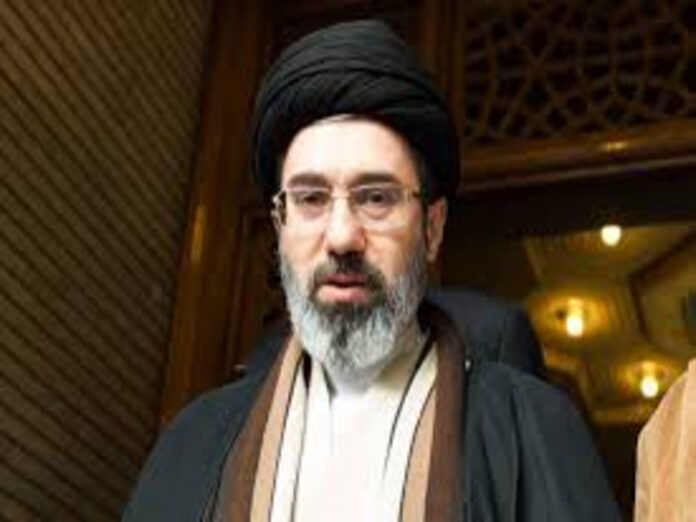
Mojtaba Khamenei’s Absence From Public View Fuels Speculation He Was Wounded During Strikes That Killed His Father, Longtime Iranian Ruler Ayatollah Ali Khamenei
Wednesday, March 11, 2026, 11:00 A.M. ET. 5 Minute Read, By Art Fletcher: Englebrook Independent News,
WASHINGTON, DC.- The sudden absence of Iran’s newly installed Supreme Leader, Mojtaba Khamenei, has fueled mounting speculation that the hardline cleric may have been wounded during a devastating U.S.–Israeli airstrike campaign that decapitated much of Tehran’s senior leadership late last month.

Multiple intelligence and media reports now indicate that Mojtaba Khamenei, the 56-year-old son of longtime Iranian ruler Ayatollah Ali Khamenei, suffered injuries during the opening phase of the conflict that erupted on February 28, 2026, when coordinated American and Israeli strikes targeted key regime facilities across Iran.
Those strikes reportedly killed Ali Khamenei and several members of his family inside a heavily guarded government compound in Tehran.
According to officials cited in international reporting, Mojtaba Khamenei survived the attack but was injured in his legs, arm, and hand, and has since remained out of public view while receiving medical treatment.
The injury reports offer a possible explanation for why Iran’s newly declared supreme leader, who was rapidly elevated to the position following his father’s death, has yet to appear publicly or deliver a formal address to the Iranian nation.
Leadership Vacuum In Tehran;
Iran’s ruling clerical establishment moved quickly to install Mojtaba Khamenei as supreme leader in the chaotic hours after his father’s death.
The decision reportedly occurred under strong pressure from the Islamic Revolutionary Guard Corps (IRGC), the powerful military-political force that dominates Iran’s security apparatus and foreign proxy networks.
While Mojtaba had long been viewed by analysts as a potential successor, his elevation was controversial even within Iran’s clerical circles. Critics argue the move effectively creates a dynastic transfer of power in a system that historically claimed to reject hereditary rule.
Foreign intelligence assessments cited in recent reporting suggest the IRGC favored Mojtaba because he is seen as a loyal hardliner likely to maintain the regime’s confrontational policies toward the United States, Israel, and Western allies.
The secrecy surrounding his condition has further complicated the already volatile situation.
Several days after his appointment, Mojtaba Khamenei still had not appeared at public rallies or government ceremonies, an unusual development for a leader assuming one of the most powerful religious-political positions in the Middle East.
In Tehran, large displays and banners of the new leader have appeared in public squares, but the cleric himself has remained absent from televised appearances and official speeches.
Conflicting Claims From Tehran;
Iranian officials have attempted to downplay the reports of injuries.
The son of Iranian President Masoud Pezeshkian publicly stated that Mojtaba Khamenei was “safe and sound,” although he did not directly deny that the cleric had been wounded in the strike.
Iranian state television has also referred to Khamenei using the term “janbaz,” a Persian phrase commonly used to describe someone who has been wounded in battle.
Security analysts say such messaging may represent an attempt by the regime to portray the new leader as a “war survivor,” while simultaneously concealing the true severity of his injuries.
Israeli intelligence sources have reportedly concluded that Mojtaba Khamenei was lightly wounded during the airstrikes but survived the attack.
Escalating Regional Conflict;
The strikes that killed Ali Khamenei and injured his son came amid a rapidly expanding war between Iran and a U.S.–Israeli coalition targeting Tehran’s military infrastructure.
The bombing campaign has reportedly degraded large portions of Iran’s missile and drone capabilities, although Iranian forces and proxy groups have continued launching retaliatory strikes across the region.
Iran has threatened attacks against shipping and Western assets, including vessels linked to the United States or Israel operating in the Strait of Hormuz, a vital corridor through which roughly one-fifth of the world’s oil supply passes.
The widening conflict has already produced significant casualties and raised fears of a broader regional war involving multiple Middle Eastern states.
Questions About The Regime’s Stability;
For decades, Iran’s Supreme Leader has served as the ultimate authority over the country’s military, judiciary, intelligence services, and nuclear program.
The death of Ali Khamenei, who ruled Iran for more than three decades, and the uncertain health of his successor have raised questions about whether Tehran’s leadership structure can maintain control during wartime.
Some analysts believe the IRGC may effectively exercise real power if Mojtaba Khamenei remains incapacitated or politically weak.
Others argue that the regime’s effort to install the son of the former supreme leader underscores what critics call the Islamic Republic’s transformation into an entrenched authoritarian dynasty.
Regardless of the outcome, the mystery surrounding Mojtaba Khamenei’s whereabouts and condition has only intensified global scrutiny of the Iranian regime at a moment when the country faces its most severe military crisis in decades.
Editor’s Note:
This article was written by Jennifer Hodges, Political Editor, and is based on verified international reporting and intelligence assessments available as of March 11, 2026. Iranian government officials have issued conflicting statements regarding the condition of Mojtaba Khamenei. Some officials claim he is “safe and sound,” while other reports, citing Israeli intelligence and diplomatic sources, indicate he was wounded during U.S.–Israeli strikes that killed his father, Ayatollah Ali Khamenei.
Because the Iranian government tightly controls information inside the country, independent verification of the new leader’s condition remains limited. Englebrook Independent News will continue monitoring developments and update this story as additional confirmed information becomes available.
Support Independent Journalism
Englebrook Independent News is powered by readers like you. Your donation helps us continue delivering trusted local, national, and political news — free for everyone.
Donate Today