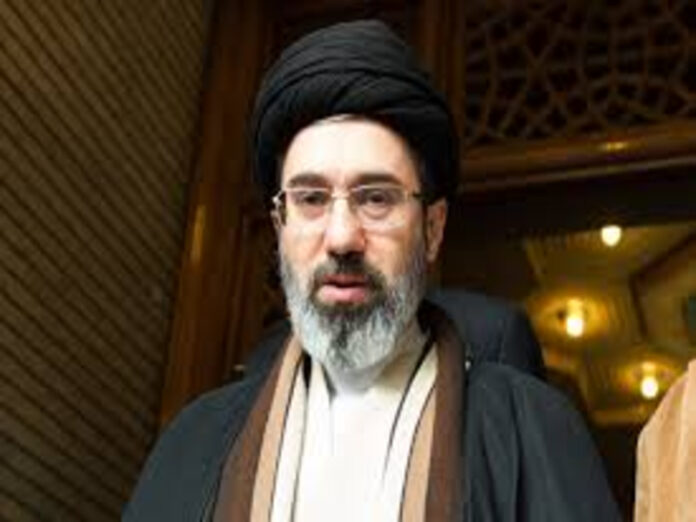
From Shadow Power Broker To Invisible Ruler, Mojtaba Khamenei’s Rise Exposes Iran’s Opaque Leadership, Entrenched Misinformation, & Deepening Crisis Of Legitimacy
Wednesday, March 18, 2026, 10:00 A.M. ET. 7 Minute Read, Opinion-Editorial, By Jennifer Hodges, Political Editor: Englebrook Independent News,
MANHATTAN, NY.- In the days following the violent death of Iran’s long-time Supreme Leader, Ayatollah Ali Khamenei, the Islamic Republic has presented the world with a successor who is, paradoxically, both all-powerful and nowhere to be seen.

Mojtaba Khamenei, 56 years old, deeply embedded within the regime, and now officially named Supreme Leader, has not appeared in public since his appointment. He has not addressed the Iranian people on camera. He has not stood before the clerical establishment in Qom. He has not even confirmed his own condition.
The question now reverberating across diplomatic circles, intelligence agencies, and global media is stark: Is Iran’s new Supreme Leader alive, incapacitated, or simply hidden?
The answer matters not only for Iran but also for the stability of an already volatile region.
A DYNASTIC ASCENT ROOTED IN SHADOW POWER;
Mojtaba Khamenei’s rise is not the result of public legitimacy or formal political achievement. Unlike previous Iranian leaders, he has never held a major elected office or a widely recognized governmental post. Instead, his influence was cultivated quietly inside the beyt—the inner office of his father, which functioned as the nucleus of power within the Islamic Republic.
For years, analysts described Mojtaba as a “shadow operator,” a figure who wielded authority behind the scenes, particularly through close ties to the Islamic Revolutionary Guard Corps (IRGC). His influence extended into intelligence coordination, clerical networks, and the internal security apparatus.
His ascent following his father’s death on February 28, 2026, was swift and controversial. Iran’s Assembly of Experts confirmed him as Supreme Leader within days, an unusually rapid process that raised immediate questions about political pressure and predetermined outcomes.
This was not a smooth constitutional transition. It was, by credible accounts, a consolidation of power driven by Iran’s most powerful military institution.
Even more striking is the widely reported claim that Ayatollah Ali Khamenei himself opposed his son’s succession, warning against hereditary rule within a system founded on revolutionary anti-monarchic principles.
The Islamic Republic, in effect, has embraced the very dynastic structure it once denounced.
THE STRIKE THAT CHANGED IRAN;
Mojtaba Khamenei’s leadership began under extraordinary circumstances. The same wave of coordinated airstrikes that killed his father also reportedly injured him and eliminated several members of his immediate family.
Iranian officials have acknowledged that he sustained physical injuries, describing him as a “war-wounded” leader. However, the extent of those injuries remains unclear.
Independent analysts and Western officials have offered far more concerning assessments. Some suggest he may be severely injured or physically compromised. Others question whether he is capable of exercising independent authority at all.
Public confirmation is nonexistent. There has been no verified video appearance, no live address, and no direct engagement with the Iranian public.
Instead, written statements, delivered through state media, have become the only evidence of his leadership.
THE INVISIBLE LEADER;
This absence is not merely unusual; it is unprecedented in modern Iranian governance.
Historically, Iran’s Supreme Leader has been a visible figure, delivering speeches, guiding policy, and reinforcing ideological authority. Mojtaba Khamenei, by contrast, governs, if he governs at all, from complete obscurity.
Iranian state media maintains that he is active and fully engaged in leadership responsibilities. At the same time, foreign intelligence assessments suggest he is being deliberately concealed, either for security reasons or due to physical limitations.
Other interpretations are more troubling: that he is unable to appear publicly, or that his role has become largely symbolic.
The result is a leadership vacuum filled not with clarity, but with speculation.
WHO REALLY CONTROLS IRAN?
In the absence of a visible Supreme Leader, attention has shifted to the power centers operating behind the scenes.
The IRGC, long a dominant force in Iran’s political, military, and economic structure, appears to have assumed a central role in shaping national policy. Its influence, already significant, may now be decisive.
A nominal leadership framework exists, including senior clerics and political figures. However, multiple assessments indicate that real authority is increasingly concentrated among military leadership and hardline factions aligned with the Guard.
Figures within Iran’s political elite, including the judiciary and parliamentary leadership, have emerged as potential intermediaries or power brokers. Yet none appear to command the singular authority traditionally associated with the Supreme Leader.
Iran, at present, may be operating under a hybrid system: a nominal religious figurehead paired with a de facto military command structure.
MISINFORMATION AS STATE STRATEGY;
Iran’s handling of Mojtaba Khamenei’s condition reflects a broader, longstanding pattern: strategic ambiguity paired with controlled misinformation.
In the days following his appointment, conflicting reports circulated widely. Claims ranged from minor injury to severe incapacitation. Iranian state outlets responded inconsistently, denying some reports, ignoring others, and offering limited confirmation without detail.
This lack of clarity is not incidental. It is a deliberate strategy.
By controlling information and limiting transparency, the regime maintains flexibility. It can project strength while avoiding scrutiny. It can preserve the illusion of continuity while managing internal instability behind closed doors.
But this approach carries significant risks.
In an era of global surveillance, real-time intelligence, and digital media, opacity does not eliminate uncertainty; it amplifies it. The absence of verifiable information erodes credibility, fuels speculation, and weakens both domestic and international confidence.
A REGIME IN CRISIS;
The uncertainty surrounding Mojtaba Khamenei is not an isolated anomaly; it is a reflection of systemic instability.
Iran’s leadership structure has been severely disrupted. Multiple high-ranking officials have been killed in rapid succession. The country faces internal unrest, economic pressure, and escalating geopolitical tensions.
Now, at the apex of its power hierarchy, sits a leader who may be injured, hidden, or unable to fully assert control.
For a regime built on centralized authority and ideological consistency, this represents a profound vulnerability.
DEAD, ALIVE—OR IRRELEVANT?
So where is Mojtaba Khamenei?
The most plausible assessment is that he is alive but either incapacitated or deliberately concealed, maintained as a symbolic authority while real power shifts elsewhere.
But the more consequential question may not be his condition.
It may be his relevance.
If Iran’s Supreme Leader is absent from public life, unable to communicate directly with the nation, and overshadowed by military authority, then the institution itself is fundamentally altered.
The mystery surrounding Mojtaba Khamenei is not simply about one man’s fate.
It is about the trajectory of the Islamic Republic, whether it remains a theocratic system centered on singular leadership or evolves into a more opaque, militarized structure in which power is diffuse, concealed, and far less accountable.
For now, the world watches a regime that insists everything is under control, even as its leader remains unseen.
And in that silence, uncertainty grows.
Editor’s Note:
This opinion column was composed by Jennifer Hodges, Political Editor, and is based on verified reporting from multiple international news agencies, including Reuters, The Associated Press, and The Guardian, as well as publicly available intelligence assessments and expert analysis. Due to restricted access to Iranian state institutions and ongoing regional conflict, certain details, particularly regarding Mojtaba Khamenei’s physical condition and public status, remain unconfirmed and subject to change.
Support Independent Journalism
Englebrook Independent News is powered by readers like you. Your donation helps us continue delivering trusted local, national, and political news — free for everyone.
Donate Today