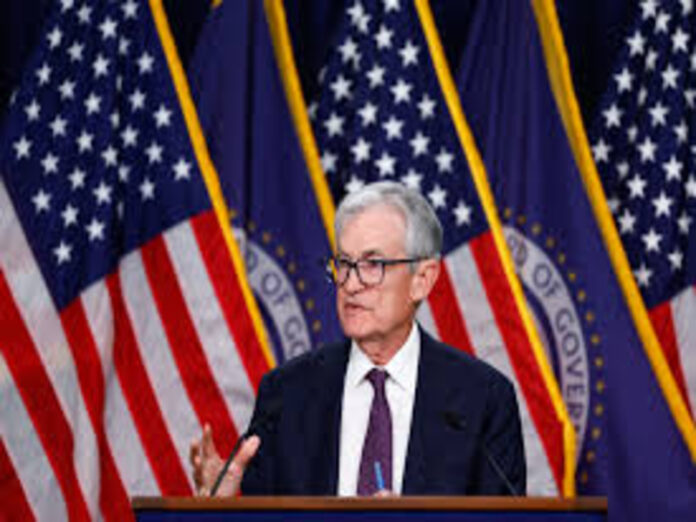
Policymakers Cite Softening Labor Market & Growing Uncertainty Tied To The Iran War As Key Factors Behind Continued Pause
Wednesday, March 18, 2026, 8:10 P.M. ET. 4 Minute Read, By Haylee Ficuciello, Economy & Finance Editor: Englebrook Independent News,
WASHINGTON, DC.- The Federal Reserve announced Wednesday that it will hold its benchmark interest rate steady, maintaining the federal funds target range at 3.5% to 3.75%, as policymakers navigate a slowing labor market, stubborn inflation, and escalating geopolitical uncertainty tied to unrest in Iran.

The decision marks the second consecutive pause by the central bank following a series of three 25-basis-point rate cuts implemented in September, October, and December of 2025, which collectively lowered borrowing costs by 75 basis points in an effort to support economic stability.
Policy Decision And Rationale;
In its official statement, the Federal Reserve indicated that while economic growth remains moderate, recent data signal a softening labor market, with slower job creation and a gradual uptick in unemployment claims. At the same time, inflation continues to run above the Fed’s long-standing 2% target, complicating the central bank’s path forward.
Officials emphasized that holding rates steady allows time to evaluate the cumulative effects of prior rate cuts while monitoring evolving risks.
“The Committee remains attentive to the risks to both sides of its dual mandate,” the statement noted, referencing the Fed’s goals of maximum employment and price stability.
While the Federal Reserve did not signal an immediate return to rate cuts, policymakers acknowledged that inflationary pressures remain uneven, particularly in core services and housing-related costs, which have proven slower to cool than anticipated.
Labor Market Signals;
Recent labor data has shown signs of deceleration. Monthly job gains have moderated compared to earlier in the year, and certain sectors, including manufacturing and retail, have reported hiring slowdowns.
Economists point to these developments as evidence that tighter monetary policy over the past two years continues to work its way through the economy. However, the Fed appears cautious about easing too quickly, given that wage growth and consumer demand have not fully stabilized.
“The labor market is no longer overheating, but it is not weak enough to justify aggressive rate cuts,” said one senior market analyst following the announcement.
Inflation Still Above Target;
Despite some improvement in headline inflation, underlying price pressures remain elevated. Core inflation metrics, excluding food and energy, continue to exceed the Fed’s target, driven in part by persistent service-sector costs.
The central bank’s pause reflects a balancing act: avoiding premature easing that could reignite inflation while also preventing excessive tightening that could push the economy toward recession.
Geopolitical Risk: Iran Conflict;
Adding to the Fed’s caution is growing instability in the Middle East, particularly related to the ongoing conflict involving Iran. Markets have reacted to heightened tensions with increased volatility in energy prices, raising concerns about potential spillover effects on global inflation.
Policymakers specifically cited uncertainty surrounding the war in Iran as a contributing factor in their decision to maintain current rates, noting that geopolitical shocks could disrupt supply chains and commodity markets.
Market Reaction And Outlook;
Financial markets showed a muted response to the announcement, as investors had largely anticipated a hold. Treasury yields remained relatively stable, while equities fluctuated modestly in afternoon trading.
Looking ahead, analysts suggest the Federal Reserve is likely to remain data-dependent, with future rate decisions hinging on clearer evidence of a sustained decline in inflation and labor market stabilization.
At present, expectations for additional rate cuts in 2026 remain uncertain, with policymakers signaling a willingness to adjust policy as conditions evolve.
Editor’s Note:
This report was written by Haylee Ficuciello, Economy & Finance Editor, and is based on the official March 2026 policy statement released by the Federal Reserve, along with current economic data and market analysis available at the time of publication. All economic indicators referenced, including labor market trends and inflation data, reflect the most recent verified figures available as of March 18, 2026. Englebrook Independent News will continue to monitor updates and provide additional analysis as new data emerges.
Support Independent Journalism
Englebrook Independent News is powered by readers like you. Your donation helps us continue delivering trusted local, national, and political news — free for everyone.
Donate Today